When wholesale buyers compare vape hardware suppliers, factory price is often the first number they look at.
But the lowest factory price does not always mean the lowest purchasing cost.
A factory-direct order can involve several stages before the buyer actually receives usable inventory:
production → quality control → international shipping → customs → local transportation → warehouse receiving
For planned large-volume orders, that process can make sense.
But what happens when you need stock quickly?
What if you want to test a new hardware model without committing to thousands of units?
What if a best-selling SKU suddenly runs out before your next factory shipment arrives?
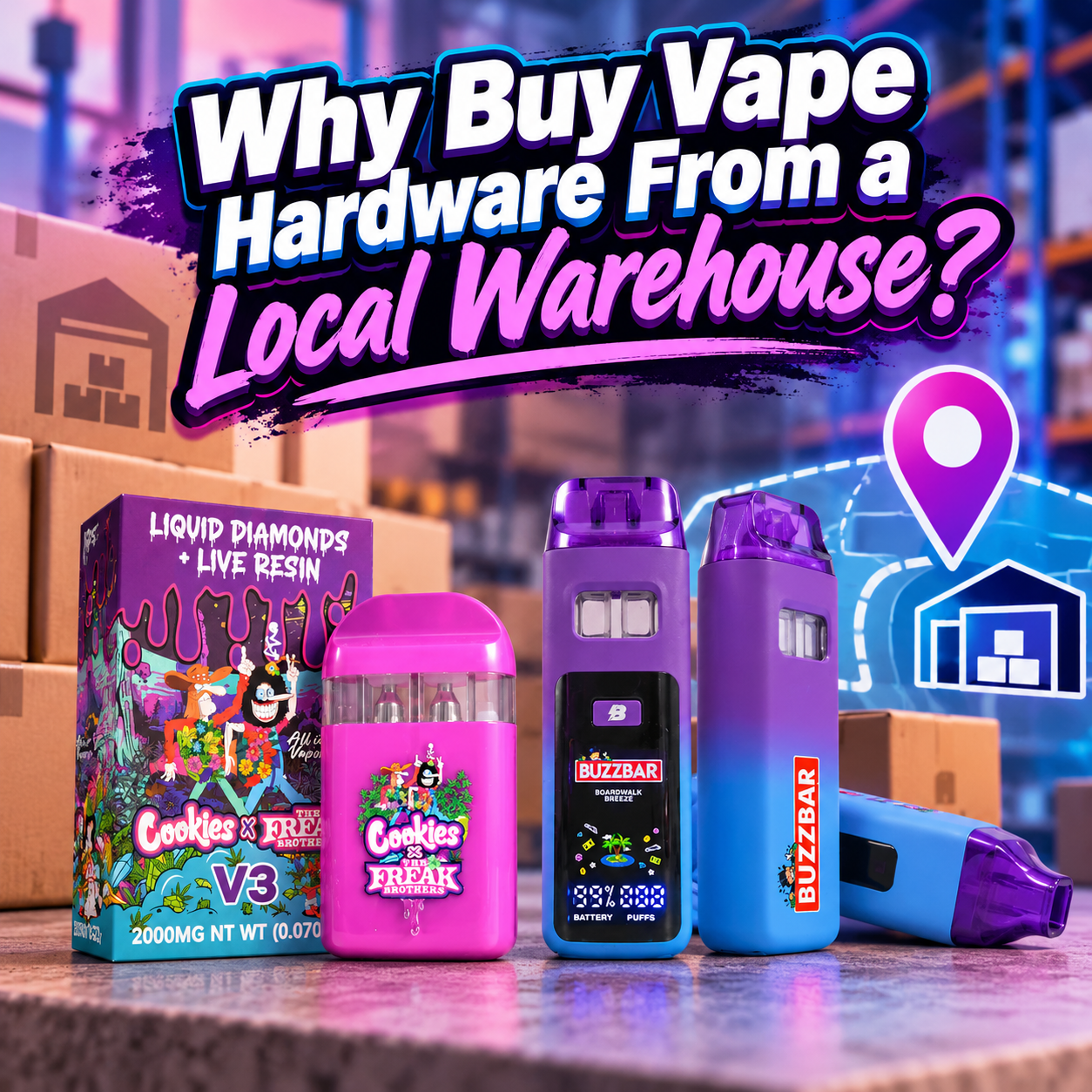
This is where local warehouse inventory can become valuable.
A local warehouse does not simply make the last delivery truck move faster. Its real advantage is that several major supply-chain steps have already taken place before the buyer places the order.
For B2B buyers, distributors, filling companies and private-label brands, that can reduce lead time, inventory commitment and purchasing uncertainty.
However, local stock also has limitations.
This guide explains when buying vape hardware from a local warehouse makes sense, when factory-direct sourcing may be better, and why many wholesale buyers can benefit from using both.
What Does “Local Warehouse” Mean for Vape Hardware?
In vape hardware wholesale, a local warehouse generally means inventory has already been produced and transported to a warehouse closer to the target buyer or market.
Depending on the supplier, this may include inventory located in regions such as:
the United States;
the United Kingdom;
the European Union;
other major distribution markets.
The important difference is where the inventory sits when the customer orders it.
A typical factory-direct supply chain may look like:
Factory
↓
Production
↓
Quality Control
↓
International Transportation
↓
Customs / Import Processing
↓
Regional Delivery
↓
Buyer
With locally stocked products, several of those steps may already have been completed:
Local Warehouse
↓
Regional / Domestic Fulfillment
↓
Buyer
That changes the purchasing equation significantly.
Local Warehouse vs Factory Direct: Quick Comparison
The most obvious advantage of local stock is shorter fulfillment time.
But the reason matters.
A factory-direct order may need to wait for:
production scheduling;
component preparation;
assembly;
customized packaging;
quality inspection;
international carrier booking;
customs processing.
A stocked product has already passed through much of that process.
The buyer is therefore purchasing existing inventory rather than waiting for a new production cycle.
A more accurate way to describe the advantage is:
Local inventory converts a long international replenishment cycle into a shorter regional fulfillment cycle.
This can matter when delivery timing affects:
filling schedules;
product launches;
retailer commitments;
customer orders;
promotional campaigns.
For some businesses, avoiding a two- or three-week inventory gap may be worth more than saving a small amount on each hardware unit.
2. No Need to Wait for a New Production Run
International transportation is not always the largest source of delay.
Sometimes the product has not been manufactured yet.
A factory-direct order can require time for:
raw materials;
components;
production-line scheduling;
assembly;
packaging;
QC;
rework if inspection finds problems.
During busy production periods, manufacturing capacity can become an important part of the lead time.
With true local inventory, those units already exist.
This makes local stock particularly useful for:
Urgent Restocking
A high-volume SKU is selling faster than expected.
Unexpected Customer Demand
A distributor receives a larger order than forecast.
Product Launch Support
A planned factory shipment is delayed but a launch date cannot easily move.
Temporary Inventory Gaps
The buyer needs enough stock to continue operating until the main bulk shipment arrives.
In this sense, a local warehouse can function as an inventory buffer.
3. Lower MOQ and Easier Trial Orders
Factory production works best at scale.
Manufacturers have to consider:
production-line setup;
component procurement;
packaging MOQ;
labor;
machine setup;
QC costs.
That is why factory-direct orders can require larger quantities.
Local stock is different.
The products have already been manufactured in a larger batch, so a supplier may be able to sell smaller quantities from that inventory.
Depending on the supplier and product, this can make it easier to buy:
a small wholesale order;
several cartons;
a limited market-test quantity.
The exact MOQ should always be confirmed with the supplier.
The important advantage is not simply that the number is smaller.
It is that buyers can commit less capital to a product they have not yet validated at scale.
4. Lower Inventory Risk
Consider a new hardware model.
You like the samples.
The specification looks promising.
But you do not yet know how your customers will respond.
One option is to place a large factory order immediately.
The problem is that if demand is lower than expected, you now own a large amount of slow-moving inventory.
Local stock can make a different sourcing strategy possible:
Sample
↓
Small Local Order
↓
Market Test
↓
Analyze Sell-Through
↓
Repeat Local Order or Factory Bulk Order
This can be summarized as:
Test → Validate → Scale
Instead of forecasting demand before you have meaningful sales data, you can first test the market with a smaller commitment.
That can be especially useful for:
new device capacities;
dual-chamber designs;
devices with screens;
new exterior designs;
unfamiliar hardware platforms.
Local inventory does not remove demand risk, but it can reduce the amount of inventory exposed to that risk.
5. Better Cash-Flow Management
Inventory consumes cash before it produces revenue.
A large factory order may require the buyer to pay for products well before the inventory is eventually sold.
Cash can remain tied up during:
manufacturing;
international transport;
customs;
warehouse storage;
final sale.
Smaller and more frequent local purchases can sometimes reduce the amount of working capital locked into inventory at one time.
For example, instead of purchasing several months of uncertain inventory in one transaction, a buyer may replenish more frequently according to actual sales.
This relates to an important supply-chain concept:
Inventory Turnover
The faster inventory can be replenished, the less safety stock a business may need to hold in some situations.
That does not mean smaller orders are always financially better.
Higher local unit prices and frequent shipping must also be considered.
The real question is:
How much cash should we commit to inventory today to support expected demand?
6. Easier Emergency Restocking
No forecasting system is perfect.
Demand changes.
Customers place unexpected orders.
Products go viral.
Promotions perform better than expected.
A large distributor may suddenly ask for inventory that was not included in the original plan.
If the only supply source is factory production, emergency replenishment can be difficult.
That is where local inventory can support a dual-sourcing strategy.
For example:
Factory Direct
Used for:
planned volume;
large repeat orders;
customized production.
Local Warehouse
Used for:
urgent replenishment;
temporary shortages;
unexpected demand.
The buyer does not necessarily have to choose one or the other.
For many established businesses, the two channels can solve different supply-chain problems.
7. Reduced International Shipping Complexity for the Buyer
When hardware is already held in a local warehouse, the international import stage may already have occurred before the local buyer places the order, depending on how the supply chain is structured.
That can simplify the buyer’s immediate logistics.
However, there is an important distinction:
Local fulfillment can simplify logistics. It does not automatically remove regulatory, tax, sales or carrier obligations.
This is particularly important for vape-related products.
In the United States, current ATF PACT Act guidance uses a broad ENDS definition that can include components, parts and accessories of covered vaping devices, even when sold separately.
Therefore:
“Ships from a U.S. warehouse” does not automatically mean “no vape-related rules apply.”
Buyers still need to understand the requirements connected to their specific product, transaction and delivery method.
8. More Predictable Delivery Planning
International supply chains contain more variables than regional fulfillment.
Factory-direct lead time can be affected by:
manufacturing schedules;
component availability;
international freight capacity;
lithium-battery transportation requirements;
customs processing;
port or airport handling.
Local inventory has already moved through many of these stages.
That can make receiving dates more predictable.
This matters for companies coordinating:
filling lines;
packaging operations;
staffing;
marketing launches;
retailer replenishment.
For example, if a filling operation is scheduled but hardware arrives late, the direct product delay is only part of the problem.
The buyer may also face:
idle equipment;
rescheduled labor;
missed customer deadlines.
Supply-chain reliability therefore has an operational value beyond freight cost.
9. Easier Small-Batch Hardware Testing
Local inventory can also support technical testing.
Before committing to large-scale production, buyers may want to compare:
1g vs 2g hardware;
single vs dual chamber;
different battery configurations;
screen vs non-screen devices;
different airflow designs.
A small local-stock order can provide enough units to conduct more meaningful testing than a few presentation samples.
Buyers can evaluate:
filling process;
charging;
airflow;
leakage;
storage performance;
customer feedback.
This is particularly useful when moving from:
“The sample works.”
to:
“The product works consistently enough for our operation.”
For serious B2B sourcing, those are different questions.
10. Shorter Replenishment Cycles Can Reduce Forecasting Risk
The longer the replenishment lead time, the further into the future a buyer must forecast.
Forecasting three months ahead is generally more uncertain than making purchasing decisions based on recent sales.
Local warehouse replenishment can shorten that decision window.
A buyer may therefore be able to purchase inventory closer to actual demand.
For example:
Instead of deciding today how many units customers may need several months from now, the buyer can use more recent:
sales data;
customer orders;
SKU performance;
retailer demand.
This can help reduce two common inventory problems:
Over-Stocking
Too much inventory is purchased and becomes slow-moving.
Under-Stocking
Demand is stronger than forecast and the business runs out before the next shipment.
Local inventory can provide greater flexibility between those two extremes.
What Are the Disadvantages of Local Warehouse Stock?
Local stock has significant benefits, but it is not always the best purchasing method.
A credible sourcing decision should consider the disadvantages as well.
1. Unit Price May Be Higher
By the time products reach a local warehouse, the supplier may already have paid for:
international transportation;
import processing;
warehousing;
inventory financing;
local fulfillment.
The supplier is also taking inventory risk by holding stock before the final customer has ordered it.
These costs can increase the local unit price.
2. Customization Is Limited
Inventory is already manufactured.
That means buyers usually cannot change major specifications such as:
chamber structure;
battery;
PCB;
shell design.
Logo and packaging customization may also be limited or unavailable.
If the project requires a complete private-label configuration, factory-direct production is usually more appropriate.
3. Inventory Is Limited
A local warehouse cannot provide every product shown in a factory catalog.
It can only ship what is physically available.
Buyers should verify:
exact model;
color;
quantity;
batch;
current availability.
4. Popular Models Can Sell Out
Local inventory solves stock problems only while inventory remains available.
A successful SKU can also run out at the supplier’s warehouse.
That is why buyers using local stock for important products should still maintain a longer-term replenishment plan.
5. Local Stock Is Not Automatically Legal or Compliant
This point is critical.
A product being physically stored in a country does not automatically mean it can legally be sold there.
For example, the UK ban on single-use vapes has been in force since 1 June 2025. The prohibition covers supply and sale, including businesses such as manufacturers, wholesalers and importers.
So:
A product sitting inside a UK warehouse does not by itself establish that the product is legal to sell in the UK.
The same principle applies in the EU.
EU importers are expected to verify that non-EU manufacturers have taken the required conformity steps and that relevant documentation is available.
Warehouse location is a logistics fact.
Compliance is a separate question.
Local Warehouse vs Factory Direct: Which Costs Less?
The answer depends on what you are comparing.
If you compare:
local warehouse unit price
against:
factory EXW unit price
the factory offer will often appear cheaper.
But these numbers do not represent the same stage of the supply chain.
A factory-direct purchase can include additional costs such as:
international freight;
customs duties;
customs brokerage;
local handling;
warehouse delivery;
financing;
additional safety stock.
A better comparison is:
Total Delivered / Landed Cost
For factory direct:
Product + Packaging + International Freight + Duties + Import Handling + Local Delivery + Inventory Cost
For local stock:
Local Product Price + Regional Shipping + Applicable Local Costs
The result may still favor factory direct for a large order.
But now the comparison is meaningful.
When Should You Choose Local Warehouse Stock?
Local inventory can make more sense when:
You Need the Product Quickly
Waiting for a new production cycle is not practical.
You Are Testing a New Model
You want more units than a sample order but are not ready for large-scale production.
You Want a Smaller Initial Commitment
Demand has not been fully validated.
Demand Is Uncertain
You prefer to replenish based on real sales.
You Need Emergency Inventory
Your main stock has unexpectedly run low.
You Want to Reduce Inventory Exposure
You do not want several months of inventory sitting in your warehouse.
You Need Bridge Inventory
Your bulk factory shipment is already in production or transit, but you need additional stock before it arrives.
That last use case is particularly powerful.
Local stock does not replace the factory order.
It bridges the gap.
When Should You Choose Factory Direct?
Factory-direct purchasing usually makes more sense when:
volume is large;
demand is stable;
OEM branding is required;
custom colors are needed;
packaging must be customized;
product specifications must be changed;
long-term repeat production is planned;
lower unit economics are important.
The more customized the project becomes, the stronger the case for factory-direct production.
The Best Strategy May Be Using Both
The most useful question may not be:
Local warehouse OR factory direct?
It may be:
How should we use both?
A hybrid strategy could look like:
Factory-Direct Supply
Supports:
planned demand;
large volume;
OEM production;
better long-term unit economics.
Local Warehouse Supply
Supports:
unpredictable demand;
emergency replenishment;
product testing;
temporary shortages.
For example, a buyer can place the main planned order directly with the factory while using local inventory only when demand exceeds the forecast.
This approach combines:
Factory efficiency + Local flexibility
The correct mix depends on the business.
Questions to Ask Before Buying Vape Hardware From a Local Warehouse
Before placing an order, ask the supplier:
1. Where is the inventory physically located?
“Local stock” should mean actual inventory, not products that will still ship internationally after purchase.
2. Is the product physically in stock now?
Ask about current availability.
3. How many units are available?
Important for repeat purchasing.
4. What is the local MOQ?
Do not assume factory and warehouse MOQs are identical.
5. What is the production or batch date?
This is particularly relevant for rechargeable hardware containing batteries.
6. Is the warehouse model identical to the factory-direct version?
Verify battery, chamber, PCB and other specifications.
7. What QC was performed on this batch?
Ask for relevant inspection information.
8. What battery documentation is available?
Important for rechargeable products.
9. What shipping method will be used?
Local does not necessarily mean every carrier is available.
10. What is the return or replacement policy?
Know how defects are handled.
11. Can the same model be reordered directly from the factory?
This matters if your trial succeeds.
12. What compliance documentation is available for the target market?
Local inventory should still correspond to the required product documentation.
Local Warehouse Buyer Checklist
Area
What to Verify
Warehouse location
Actual physical inventory location
Availability
Current quantity
Product model
Exact configuration
Production batch
Production / batch date
Battery
Specification and documents
QC
Relevant inspection records
MOQ
Local-order minimum
Delivery
Regional method and expected timing
Compliance
Destination-market requirements
Replenishment
Factory-direct availability
Returns
Defect / replacement process
Cost
Total delivered cost
USA, UK and EU Local Warehouses: Important Differences
Local warehouse strategy should always be connected to the destination market.
USA Warehouse
U.S.-based stock can reduce international replenishment time for domestic buyers.
However, U.S. vape-related distribution rules remain important.
ATF’s current PACT Act guidance includes components, parts and accessories within its ENDS framework in covered circumstances.
Therefore, U.S. warehouse inventory should not be promoted as automatically free of vape-related shipping or business requirements.
UK Warehouse
UK inventory requires particularly careful product classification.
Single-use vapes have been banned from sale and supply since 1 June 2025.
Another major change starts on 1 October 2026: the UK Vaping Products Duty applies to vaping liquids within its scope, including nicotine-free vaping liquid, at a flat rate of £2.20 per 10 ml. HMRC is also introducing the Vaping Duty Stamps Scheme.
For sellers of empty hardware, the distinction between hardware and duty-liable vaping liquid is important.
Do not assume that every rule applying to filled products applies identically to empty devices—or vice versa.
Product classification should be verified before selling from UK stock.
EU Warehouse
EU warehouse inventory can shorten regional delivery time, but warehouse location does not replace EU conformity obligations.
European Commission guidance states that importers bringing products from outside the EU must verify that the manufacturer has taken the necessary compliance steps and that relevant conformity and technical documentation is available.
For vape hardware, this may involve evaluating areas such as:
product classification;
TPD;
CE-marking legislation;
RoHS;
GPSR;
batteries;
WEEE;
Member-State rules.
Therefore:
EU Stock ≠ Automatically EU Compliant
Treat logistics and compliance as two separate checks.
Common Mistakes Buyers Make With Local Stock
Mistake 1: Comparing Local Price Directly With Factory EXW Price
They represent different stages of the supply chain.
Compare total delivered cost.
Mistake 2: Assuming “Local Warehouse” Means Unlimited Inventory
Always verify quantity.
Mistake 3: Assuming Local Stock Can Be Fully Customized
Most major specifications were fixed during production.
Mistake 4: Ignoring Production Date and Batch Information
Know which inventory you are buying.
Mistake 5: Assuming Local Stock Is Automatically Compliant
Warehouse location does not determine legality.
Mistake 6: Buying Large Quantities Without Testing the Hardware
Local availability does not eliminate the need for product evaluation.
Mistake 7: Having No Factory Replenishment Plan
If local stock sells out, what happens next?
Mistake 8: Choosing Only by Delivery Speed
Fast delivery does not compensate for poor product quality or the wrong specification.
Frequently Asked Questions
Is vape hardware more expensive from a local warehouse?
Often, yes.
The local price may already reflect international transportation, import costs, warehousing, inventory financing and regional fulfillment.
However, the correct comparison is total delivered cost rather than local price versus factory EXW price.
Is local warehouse stock better than factory direct?
Neither is always better.
Local stock is often better for speed, smaller orders and flexible replenishment.
Factory direct is generally stronger for large volume, OEM customization and lower long-term unit economics.
Can I order smaller quantities from a local warehouse?
Often, but this depends on the supplier and model.
Ask for the exact warehouse MOQ before ordering.
Can local warehouse vape hardware be customized?
Usually only to a limited extent because the inventory has already been manufactured.
For custom hardware, colors, branding or packaging, factory production is usually more suitable.
How do I know whether inventory is really local?
Ask for:
physical warehouse location;
current quantity;
batch information;
expected shipping origin.
A local-stock order should not unexpectedly turn into an international shipment after purchase.
Is local warehouse stock automatically compliant?
No.
Local warehouse location is a supply-chain characteristic, not a regulatory approval.
The product must still satisfy applicable rules for the destination market.
Can local stock help while I wait for factory production?
Yes.
This is one of its most useful B2B applications.
A buyer can use local inventory as bridge stock while the main factory order is being produced or transported.
Should I buy local stock or place a factory order?
Consider:
urgency;
quantity;
customization;
demand certainty;
inventory risk;
total delivered cost.
For many businesses, the answer may be to use both channels for different purposes.
Final Thoughts
The biggest benefit of buying vape hardware from a local warehouse is not simply faster shipping.
By purchasing inventory that has already been manufactured and moved closer to the target market, wholesale buyers can shorten replenishment cycles, test products with smaller commitments and respond more quickly to unexpected demand.
But those advantages come with trade-offs:
Higher Unit Cost + Limited Customization + Limited Inventory
That is why local warehouse sourcing should not automatically replace factory-direct purchasing.
When all eight are clear, local inventory becomes more than a faster shipping option.
It becomes a practical supply-chain tool for reducing purchasing uncertainty.
Regulatory Disclaimer: This article provides general B2B purchasing and supply-chain information and does not constitute legal, customs, tax or regulatory advice. Requirements vary according to product configuration, intended use, transaction structure and destination market.
Hello, please contact us if you have any questions! Whatsapp : +1-713-363-1015 Telegram : @Amy99812 Email : chengstella120@gmail.com iMessage: +1-713-363-1015
We have received your message and we will contact you as soon as possible!