
Empty Disposable Vape MOQ Explained: Wholesale, OEM & Custom Order Guide
When sourcing empty disposable vape hardware, one of the first questions wholesale buyers usually ask is: “What is your MOQ?”
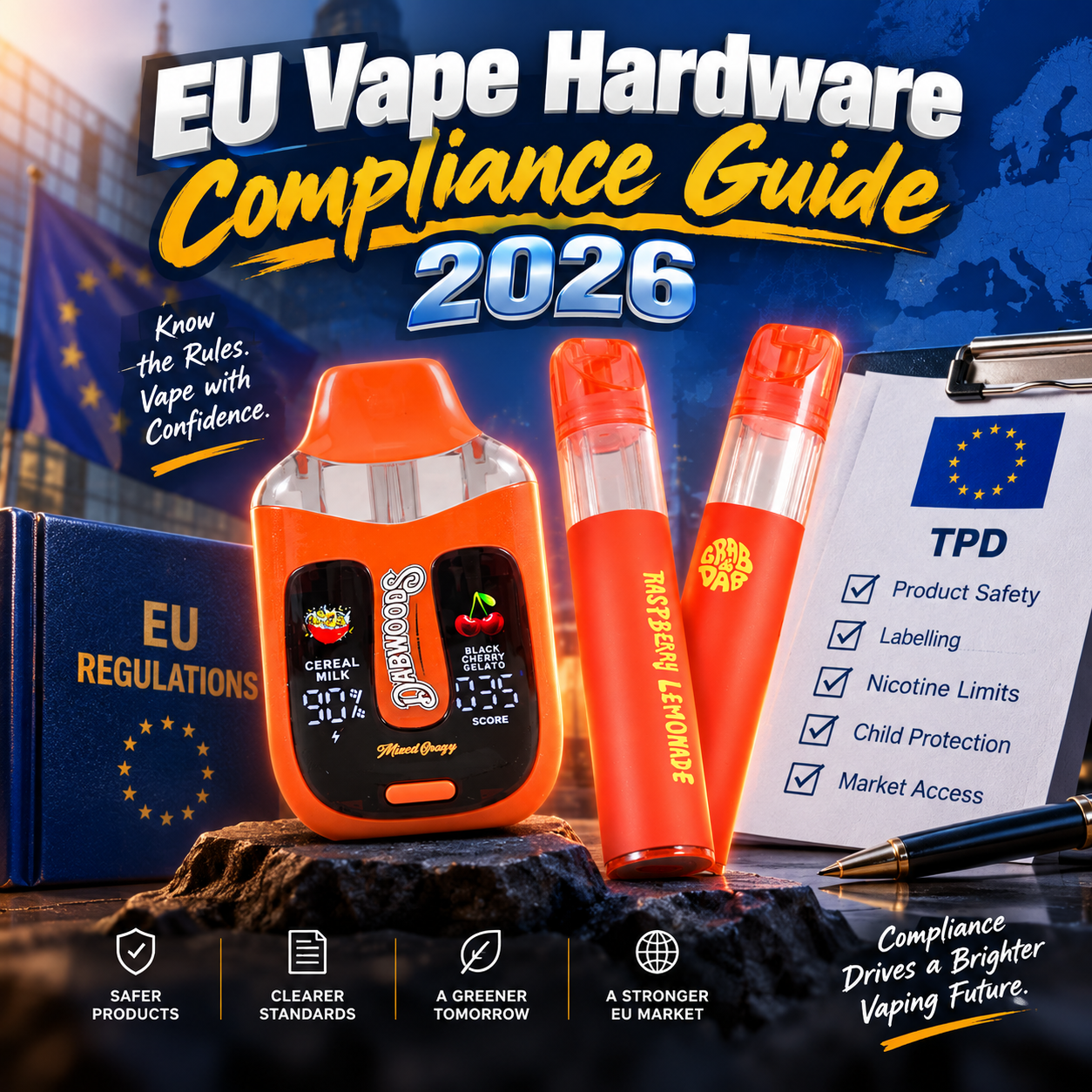
Selling vape hardware in the European Union is not simply a matter of asking a supplier for a “CE certificate.”
Depending on the exact product, an empty vape device may sit at the intersection of several different EU regulatory frameworks covering tobacco-related products, electrical equipment, hazardous substances, batteries, waste, product safety and market surveillance.
A rechargeable empty vape device may potentially need to be assessed against areas such as:
The most important point for wholesale buyers is therefore:
EU compliance starts with the exact product configuration and intended use—not with a folder of generic certificates.
An empty device, a nicotine-filled disposable product, a cartridge without electronics and a rechargeable dual-chamber device may not have exactly the same regulatory obligations.
This 2026 guide explains the major compliance areas B2B buyers, importers and private-label brands should review before placing vape hardware on the EU market.
Regulatory note: This article provides general information as of September 2026. It is not legal advice. EU and Member-State rules can change, and the correct regulatory assessment depends on the exact product and market.
Before asking whether a product is “CE compliant” or “TPD compliant,” first determine what the product actually is.
Important questions include:
This classification stage matters because different regulations have different scopes.
A common mistake is to assume:
“The device is empty, therefore vape-specific rules cannot apply.”
The EU Tobacco Products Directive is broader than that assumption.
Directive 2014/40/EU defines an “electronic cigarette” as a product that can be used for the consumption of nicotine-containing vapour, including components such as a cartridge, tank and even the device without a cartridge or tank.
That does not mean every empty component has exactly the same obligations as a finished nicotine-containing product.
It means buyers should perform a product-specific assessment instead of using “empty” as an automatic exemption.
The main EU tobacco-related legislation for electronic cigarettes remains Directive 2014/40/EU, usually called the Tobacco Products Directive or TPD.
Article 20 contains the principal EU rules relating to electronic cigarettes and refill containers.
For products within its notification requirements, manufacturers and importers must submit specified product information to the relevant Member-State authorities before placing new or substantially modified products on the market.
The European Commission’s current EU Common Entry Gate guidance states that information for e-cigarettes and refills must generally be submitted six months before the intended market-placement date.
For B2B buyers, this means product development timelines may need to include more than:
sample → production → shipping
They may also need to include:
classification → regulatory submission → waiting period → market placement
where the notification obligation applies.
This is one of the most important questions for an empty vape hardware buyer.
The answer should not be reduced to:
“Empty = TPD exempt.”
As noted above, the TPD definition of an electronic cigarette includes components and the device without a cartridge or tank.
However, individual Article 20 requirements also depend on the particular product.
For example, the Directive specifically states that nicotine-containing liquid may be marketed in disposable electronic cigarettes or single-use cartridges/tanks only where the cartridge or tank does not exceed 2 ml, and nicotine-containing liquid must not exceed 20 mg/ml.
Those provisions concern nicotine-containing products and should not simply be copied onto every empty hardware specification without analysis.
A more accurate B2B approach is to ask:
The correct conclusion is:
Being empty can change the compliance analysis, but it does not automatically eliminate the need for a TPD assessment.
Another common sourcing question is:
“Does every vape need CE?”
Not simply because it is a vape.
CE marking exists because a product falls within specific EU harmonisation legislation that requires the CE mark.
The European Commission states clearly that CE marking is only mandatory for products covered by EU rules that specifically require it. If no such requirement applies, the CE mark must not be used.
This also means there is no universal EU authority that issues a generic:
“CE certificate for vape products.”
The manufacturer must instead:
For vape hardware containing electronics, potentially relevant CE-marking legislation can include areas such as:
Therefore, instead of asking a supplier:
“Do you have CE?”
ask:
“Which EU legislation is this exact model declared compliant with?”
Rechargeable vape devices contain electrical and electronic components such as:
These make the Restriction of Hazardous Substances Directive (RoHS) particularly relevant.
The European Commission currently lists ten restricted substances under RoHS:
The Commission also states that products containing electrical or electronic components generally need to comply with the restrictions unless they fall within a specific exclusion.
For buyers, simply receiving a document named:
“RoHS Certificate.pdf”
is not enough.
Check:
If a supplier changes the PCB, solder, housing material or another relevant component after testing, the compliance file may need to be reassessed.
A test report for Model A should not automatically be treated as evidence for Model B.
A rechargeable vape device is an electronic apparatus.
Depending on the design, the Electromagnetic Compatibility Directive 2014/30/EU may therefore need to be assessed.
The Directive defines apparatus as a finished appliance or combination made available as a functional unit that may generate electromagnetic disturbance or whose performance may be affected by electromagnetic disturbance.
Relevant evaluation may consider issues such as:
A device containing:
may require a different technical assessment from a very simple non-electronic component.
Buyers should request the conformity documentation for the actual electronic configuration being purchased, particularly where PCB or display versions differ between production batches.
The Low Voltage Directive is another area where generic supplier certificate lists can become misleading.
Directive 2014/35/EU applies to electrical equipment designed for:
A typical small rechargeable vape device operates at a DC voltage far below 75 V.
Therefore, the vape device itself will often fall outside the voltage range of the LVD.
This is why buyers should be cautious when a supplier automatically lists:
CE / EMC / LVD / RoHS
for every small battery-operated device without explaining the regulatory basis.
A separately supplied mains charging adapter may be a different matter and may require its own conformity assessment.
The practical lesson is:
Do not collect directives. Determine which directives actually apply.
Electrical compliance is only part of the picture.
Vape hardware also contains materials such as:
These can raise obligations under REACH, the EU chemicals framework.
One important B2B requirement involves substances on the REACH Candidate List.
ECHA states that when an article contains a Candidate List substance above 0.1% weight by weight, suppliers must provide sufficient information to professional recipients to allow safe use, at minimum identifying the substance. Consumers can also request relevant information, which must be supplied free of charge within 45 days.
For vape hardware sourcing, buyers can consider requesting:
Again, ask which components are covered.
A generic document saying:
“Our products comply with REACH”
provides less useful information than a declaration clearly linked to the exact materials and model.
REACH and SCIP are related, but they are not the same obligation.
The ECHA SCIP database concerns articles containing Candidate List substances above 0.1% w/w placed on the EU market.
ECHA states that relevant parties can include:
The SCIP notification obligation has applied since 5 January 2021.
This matters particularly for EU importers.
A Chinese hardware manufacturer may provide material information, but the legal duty to make a SCIP submission may fall on an EU supply-chain actor depending on the commercial structure.
Therefore:
REACH test report ≠ SCIP registration
and:
Chinese supplier declaration ≠ completion of the EU importer’s obligations.
For rechargeable vape hardware, Regulation (EU) 2023/1542 on batteries and waste batteries is becoming increasingly important.
The regulation applies progressively.
It generally began applying from 18 February 2024, while its extended-producer-responsibility and waste-management Chapter VIII has applied from 18 August 2025.
For vape hardware, buyers should identify:
Do not confuse EU battery product compliance with lithium-battery transport testing.
For example:
UN 38.3 concerns lithium-battery transport safety.
It is not a substitute for compliance with the EU Batteries Regulation.
A supplier saying:
“Battery has UN38.3, therefore the vape is EU compliant”
is combining two different regulatory questions.
This is one of the most important forward-looking issues for vape hardware manufacturers in 2026.
Article 11 of Regulation (EU) 2023/1542 will apply from 18 February 2027.
As a general rule, products incorporating portable batteries must be designed so that the battery is readily removable and replaceable by the end user during the product’s lifetime, subject to the specific derogations and conditions in the regulation.
The European Commission published dedicated interpretive guidance in 2025 confirming the February 2027 start date and explaining concepts such as commercially available tools, replaceability and available derogations.
This is particularly important for manufacturers designing:
However, buyers should not jump to the conclusion:
“All sealed disposable vapes will automatically become illegal in February 2027.”
Article 11 contains exceptions and requires product-specific legal and engineering analysis.
The practical recommendation is simpler:
If you are developing a sealed battery vape platform for the EU market in 2026, assess Article 11 now rather than after the product has entered mass production.
Hardware developed today may still be sold after February 2027.
A vape device containing electrical and electronic components can also create obligations under the WEEE Directive 2012/19/EU.
WEEE is fundamentally different from an EMC or RoHS laboratory test.
It concerns the end-of-life management of electrical and electronic equipment and includes producer registration, reporting and waste responsibilities.
Article 16 requires Member States to maintain registers of EEE producers, including businesses supplying EEE through distance selling. Producers engaged in distance sales must generally register in the Member State into which they sell, directly or through the appropriate authorised-representative structure where required.
The definition of “producer” can include a company that:
This is particularly relevant for private-label vape brands.
You may purchase the device from a Chinese manufacturer, but if you import and market it under your own business structure in Europe, you may have obligations that cannot simply be outsourced by asking the factory for a “WEEE certificate.”
One of the most important recent changes to EU product compliance is the General Product Safety Regulation (EU) 2023/988.
GPSR has applied since 13 December 2024 and provides a horizontal safety framework for consumer products, complementing sector-specific EU legislation where relevant.
For manufacturers, Article 9 requires an internal risk analysis and technical documentation before placing covered products on the market. The technical file should describe the product and relevant safety characteristics and, where appropriate, include identified risks, mitigation measures and supporting test results.
Manufacturers must also keep the relevant GPSR technical documentation available to market-surveillance authorities for 10 years after the product is placed on the market.
This is an important shift in thinking.
Compliance is not simply:
“We passed testing.”
A professional compliance file should also answer:
For vape hardware, the risk assessment might consider issues such as:
The exact analysis must be appropriate to the product.
For products covered by the GPSR, Article 16 provides that the product must not be placed on the EU market unless there is a responsible economic operator established in the Union.
Depending on the supply chain and applicable product legislation, this economic operator may be:
The responsible party’s details can also need to appear on the:
as applicable.
This is particularly important for Chinese manufacturers selling directly into Europe.
Do not assume that simply putting:
“EU REP”
on a package solves the issue.
The role must be legally established and the responsible party must actually perform the required functions.
Traceability is increasingly important under EU product rules.
GPSR requires manufacturers to provide a:
Where the size or nature of the product makes direct marking impractical, the identification may be placed on packaging or accompanying documentation.
For a vape-hardware supplier, a useful traceability system might connect:
Model → Production Batch → QC Record → Customer Order → Shipment
For example:
Model: VB-DC20Batch: 2026-0905-A
could link back to:
This provides benefits for both compliance and quality control.
If a defect is identified later, the company can determine whether it affects:
There is no single universal folder structure that applies identically to every vape device.
However, a B2B buyer can use the following as a practical documentation checklist.
Where appropriate:
Where applicable:
Where applicable:
Where applicable:
The point is not to create a large folder.
It is to create documentation that actually corresponds to the product being sold.
The EU Declaration of Conformity, often abbreviated as DoC, is frequently confused with a laboratory certificate.
They are different documents.
A test report records testing performed against specified requirements.
The EU Declaration of Conformity is the manufacturer’s formal declaration that the product complies with the applicable EU harmonisation legislation that requires the declaration.
For CE-marked products, the European Commission lists preparation and signing of the EU Declaration of Conformity as a core step in the conformity process.
A professional buyer should therefore review:
If a DoC lists legislation that clearly does not match the product, that should trigger further questions.
Likewise, if the hardware design changes significantly after the DoC is issued, the compliance assessment may need updating.
EU compliance is not solely the manufacturer’s responsibility.
When products are imported from outside the EU, the EU importer also has duties.
The European Commission states that importers must verify that the non-EU manufacturer has taken the necessary compliance steps and that required documents, such as the EU Declaration of Conformity and technical documentation, are available where relevant. Importers must also be able to maintain contact with the manufacturer.
Distributors are also expected to understand applicable compliance requirements and help prevent non-compliant products from reaching the market.
An especially important issue for private-label buyers is branding.
Under EU product rules, a company that sells a product under its own name or trademark can, depending on the applicable legislation, take on manufacturer responsibilities. The Commission’s CE guidance specifically warns that an importer or distributor marketing a product under its own name can assume the manufacturer’s legal responsibilities.
So if you buy hardware from China, put your own brand on it and sell it in Europe, do not assume:
“The factory is responsible for everything.”
Your role in the supply chain matters.
“EU compliant” does not necessarily mean:
one regulatory file automatically covers all 27 EU countries with no additional work.
EU regulations and directives create a common framework, but electronic cigarettes can also be subject to Member-State requirements involving:
TPD itself is a Directive implemented through Member-State legal systems.
WEEE registration is also operated through national producer registers.
Therefore, buyers should define the destination country before approving a product.
For example, instead of asking:
“Can we sell this in Europe?”
ask:
“What do we need to place this exact model on the market in Germany, France, Poland or the Netherlands?”
That produces a much more useful compliance analysis.
Another common mistake is mixing product-market rules with transportation rules.
They solve different problems.
May involve:
May involve:
A battery can satisfy relevant transport-testing requirements while the finished product still lacks EU product documentation.
Conversely, a product may have a complete EU compliance file but still require additional dangerous-goods paperwork before an airline accepts the shipment.
Always evaluate these separately.
Empty status alone does not determine the complete regulatory classification.
TPD’s definition of electronic cigarettes includes components and devices without cartridges or tanks.
There is no single EU authority issuing a generic CE approval.
The manufacturer determines the applicable legislation, performs conformity assessment and issues the required declaration.
Compliance evidence should match the materials, electronics and exact configuration being sold.
Typical low-voltage battery devices may fall below the LVD’s 75 V DC threshold.
Since December 2024, GPSR has significantly strengthened expectations around risk analysis, documentation and traceability.
WEEE is not solved by a laboratory test. Producer registration and environmental responsibilities may exist in the target country.
The EU Batteries Regulation is already being phased in, and Article 11’s removability and replaceability rules begin applying on 18 February 2027.
UN 38.3 addresses lithium-battery transport testing. It does not replace TPD, GPSR, RoHS, WEEE or other applicable EU rules.
EU-level legislation should be considered the starting point, not necessarily the entire country-specific market-access analysis.
Importers, brand owners, distributors and other economic operators can have their own obligations.
Before placing an empty vape hardware order for the European market, review the following areas.
| Compliance Area | What the Buyer Should Verify |
|---|---|
| Product classification | Exact hardware, battery, intended use |
| TPD | Scope and notification requirements |
| EU-CEG | Submission status where applicable |
| CE marking | Which legislation actually requires CE |
| EMC | Applicability to electronic design |
| LVD | Whether voltage falls within scope |
| RoHS | Exact-model restricted-substance evidence |
| REACH | SVHC/material information |
| SCIP | Whether notification obligations are triggered |
| Batteries Regulation | Battery/product requirements |
| 2027 battery rule | Removability/replaceability assessment |
| WEEE | Producer registration and EPR |
| GPSR | Risk assessment and technical documentation |
| EU economic operator | Responsible EU-based entity |
| Traceability | Model/batch identification |
| DoC | Correct legislation and model |
| Transport | Battery shipping documentation |
| National rules | Target Member State requirements |
Instead of asking only:
“Do you have CE and RoHS?”
ask these questions.
The answer should identify specific legal instruments rather than simply saying “EU standard.”
This can influence the TPD analysis.
Ask for the relevant product-identification information.
Check whether the list makes sense for the hardware.
Model numbers should correspond.
Ask which materials are covered.
Separate EU battery-product requirements from transport documents.
This is particularly important for sealed rechargeable devices intended to remain on the market into 2027.
Traceability should connect the hardware to production and QC records.
Do not assume the Chinese supplier automatically performs this role.
Confirm the actual company and legal role.
Previous experience does not guarantee compliance, but it can reveal whether the supplier understands the destination market.
Empty hardware is not automatically outside the TPD simply because it contains no liquid.
The TPD definition of electronic cigarettes includes components and a device without a cartridge or tank.
The actual obligations must be assessed based on the product’s design, intended use and Member-State implementation.
Possibly, but not simply because it is a vape.
CE marking applies where the product falls under specific EU harmonisation legislation requiring CE.
Electronic vape hardware may fall within legislation such as RoHS and EMC depending on its design.
No.
CE is a conformity marking for products covered by applicable EU harmonisation legislation.
There is no central EU authority that simply issues a generic “CE certificate.”
Electrical and electronic products generally fall within RoHS unless specifically excluded.
The exact scope and product configuration should still be confirmed.
Materials and articles can create REACH obligations, particularly where Candidate List SVHC substances are present.
Suppliers should maintain suitable material and SVHC information.
SCIP is an ECHA database for information on articles containing Candidate List SVHC substances above 0.1% w/w.
Relevant EU producers, importers and certain distributors can have notification obligations.
If the product qualifies as electrical or electronic equipment and the company qualifies as a “producer” under WEEE rules, producer-registration and related obligations may apply.
Registration operates at Member-State level.
The General Product Safety Regulation is the EU’s horizontal consumer-product safety regulation.
For products within scope, manufacturers must perform risk analysis, maintain technical documentation and meet traceability and safety obligations.
Products covered by GPSR cannot be placed on the EU market without an applicable economic operator established in the Union who performs the required responsibilities.
The exact legal role depends on the supply chain.
Article 11 of the EU Batteries Regulation begins applying on 18 February 2027 and establishes a general end-user removability and replaceability requirement for portable batteries, subject to its specific exceptions and conditions.
Sealed vape hardware intended for the EU market should be assessed against this requirement.
No.
UN 38.3 relates to lithium-battery transportation.
It does not replace applicable EU product-market rules such as TPD, RoHS, GPSR, WEEE or the Batteries Regulation.
Not necessarily.
EU legislation creates a common framework, but country-specific notification, taxation, environmental and vape rules can still apply.
EU vape hardware compliance is not a collection of logos.
It is a product-specific process.
A professional compliance workflow should look more like this:
Product Classification
↓
Identify Applicable EU Legislation
↓
Assess Product Design
↓
Perform Required Testing
↓
Prepare Risk Analysis and Technical Documentation
↓
Issue Required Declarations
↓
Establish EU Economic-Operator Responsibilities
↓
Complete Environmental and Producer Registrations
↓
Check Member-State Requirements
↓
Maintain Batch Traceability
For wholesale buyers, this changes the way supplier compliance should be evaluated.
Do not ask only:
“Do you have CE, RoHS and MSDS?”
Ask:
“Which regulations apply to this exact product, and what evidence supports each requirement?”
A supplier that can answer that question clearly provides much more useful information than one that sends a folder containing unrelated certificates from multiple products.
The same principle applies to empty vape hardware.
Its regulatory status should be determined from:
the exact device + intended use + battery configuration + branding structure + destination country
rather than from the word “empty.”
And for rechargeable hardware being developed in 2026, the upcoming 18 February 2027 EU battery removability and replaceability requirements deserve particular attention before tooling and mass production are finalized.
Compliance is much easier to build into a product before production than to repair after thousands of units have already been manufactured.
Get A Free Quote
Related blogs
Empty Disposable Vape MOQ Explained: Wholesale, OEM & Custom Order Guide
When sourcing empty disposable vape hardware, one of the first questions wholesale buyers usually ask is: “What is your MOQ?”

Ceramic Coil Disposable Vape Explained: How It Works, Benefits & B2B Buying Guide
Ceramic coil is one of the most common terms buyers encounter when sourcing empty disposable vape hardware. But what does
How Long Does Empty Disposable Vape Shipping Take?
For wholesale buyers, shipping time is more than a logistics question. It affects inventory planning, product launches, cash flow, reorder
You must be 18 years of age or older to view page. Please verify your age to enter.
Your access is restricted because of your age.

Hello, please contact us if you have any questions!
Whatsapp : +1-713-363-1015
Telegram : @Amy99812
Email : chengstella120@gmail.com
iMessage: +1-713-363-1015