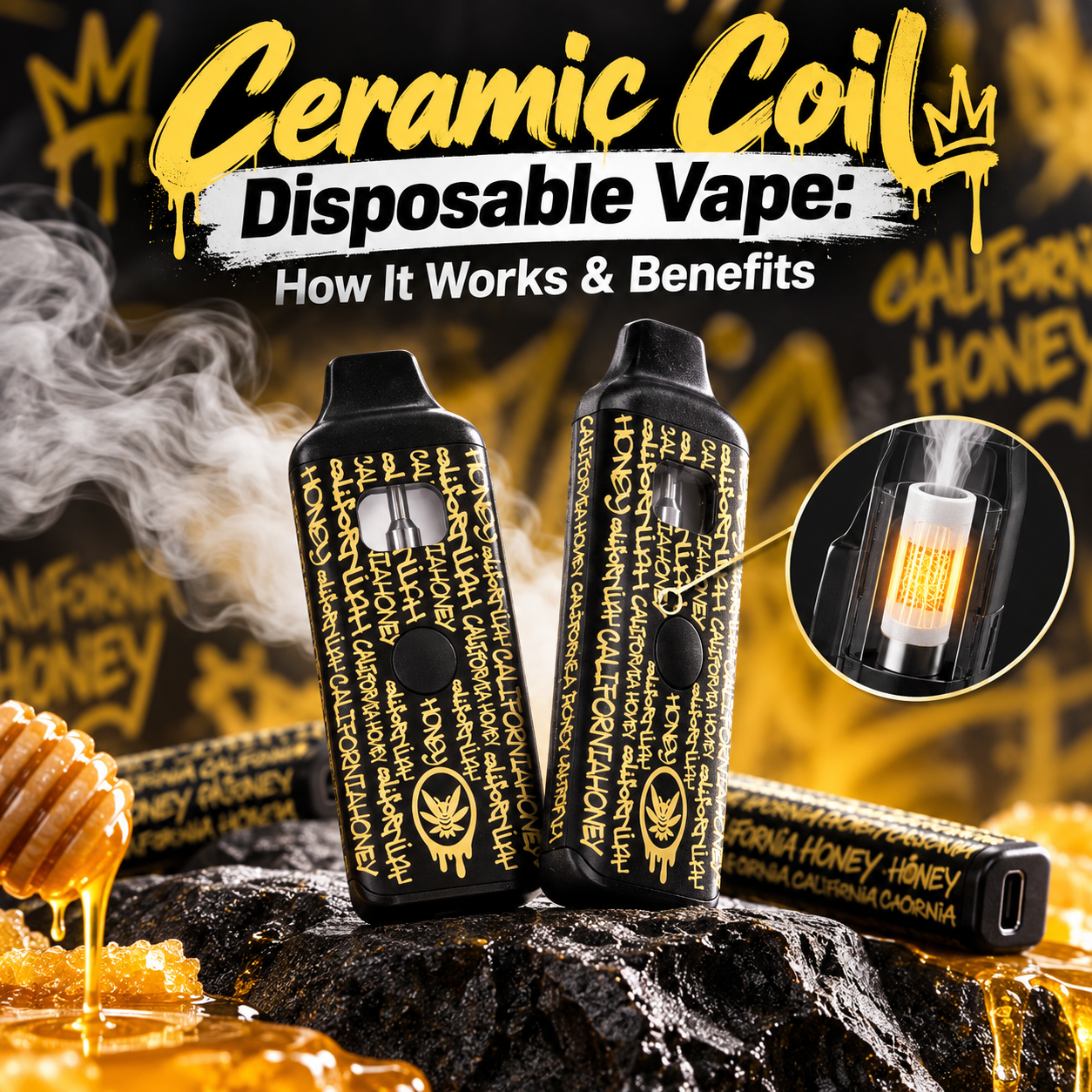
Ceramic coil is one of the most common terms buyers encounter when sourcing empty disposable vape hardware.
But what does “ceramic coil” actually mean?
A ceramic coil disposable vape uses a ceramic-based heating structure as part of the system that delivers heat to the vape formulation and generates aerosol. Depending on the design, the ceramic structure can also play an important role in moving the formulation toward the heating area.
However, ceramic coil is a broad product description—not a single standardized heating design.
Two empty disposable vapes can both be described as using ceramic coils while having very different:
ceramic structures;
heating elements;
resistance values;
oil inlet designs;
output voltages;
airflow systems;
battery configurations;
tank geometries.
As a result, asking:
“Does this disposable use a ceramic coil?”
is only the beginning of a B2B hardware evaluation.
For wholesale buyers, brands and filling operations, the more useful question is:
How well does the complete ceramic heating system work with my formulation, filling process and target product?
This guide explains how ceramic coil disposable vape hardware works, how it compares with other heating technologies, what resistance and voltage mean, why formulation compatibility matters, and how to test ceramic hardware before placing a bulk order.
What Is a Ceramic Coil Disposable Vape?
A ceramic coil disposable vape uses a ceramic-based structure within its heating system.
A simplified device can be viewed as:
Tank / Oil Chamber
↓
Oil Inlet
↓
Ceramic Heating Structure
↓
Heating Element
↓
Airflow Path
↓
Mouthpiece
When the device activates, electrical energy is supplied to the heating element.
The formulation reaching the heating zone is heated and aerosol is generated. The airflow path then carries the aerosol toward the mouthpiece.
The ceramic structure can play more than one role depending on the design.
It may influence:
formulation delivery;
heat distribution;
contact with the heating area;
thermal behavior;
aerosol consistency.
This is why ceramic coil performance should not be evaluated as an isolated component.
It is part of a complete hardware system.
How Does a Ceramic Vape Coil Work?
The exact mechanism varies by design, but a ceramic heating system can generally be understood through five stages.
1. The Formulation Reaches the Ceramic Structure
The formulation stored in the tank must move toward the heating area.
The design of the oil inlet and surrounding tank structure influences how quickly this happens.
If liquid delivery is too slow relative to heating demand, the heating area may not remain adequately supplied.
If liquid delivery is too fast, the system may experience oversupply or flooding-related problems.
The objective is therefore not simply:
maximum liquid flow
but:
controlled liquid delivery.
2. The Ceramic Structure Distributes the Formulation
Many ceramic heating systems use porous ceramic structures.
Depending on their design, formulation can move through or across this structure toward the active heating area.
Factors such as:
pore structure;
ceramic dimensions;
formulation viscosity;
temperature;
oil inlet geometry;
can influence this process.
This is one reason the same ceramic hardware may behave differently with two different formulations.
3. The Heating Element Receives Electrical Power
When the device is activated, the battery and electronics supply power to the heating element.
Activation may occur through:
draw activation;
a button;
a preheat function;
a combination of control methods.
The electrical behavior depends partly on:
Voltage + Resistance
but these numbers alone do not describe the complete heating performance.
4. Heat Is Transferred Through the Heating Structure
The heating element converts electrical energy into heat.
That heat interacts with the ceramic structure and formulation in the heating zone.
The actual thermal behavior depends on factors including:
heating-element geometry;
resistance;
voltage;
ceramic material and structure;
heating surface;
formulation;
airflow.
This is why two devices with the same resistance can still perform differently.
5. Aerosol Travels Through the Airflow Path
Once aerosol is generated, airflow carries it toward the mouthpiece.
The final experience therefore also depends on:
airway diameter;
airflow resistance;
inlet geometry;
mouthpiece design;
condensation behavior.
The coil cannot compensate for every weakness elsewhere in the device.
Are All Ceramic Coils the Same?
No.
This is one of the most important points for wholesale buyers.
“Ceramic coil” is often used as a marketing specification, but it does not tell you everything about the heating system.
Consider two products:
Device A: Ceramic Coil
Device B: Ceramic Coil
That description alone does not establish that they use the same technology or will produce similar results.
A more useful comparison looks at:
Variable
Why It Matters
Ceramic structure
Influences liquid delivery and thermal behavior
Porosity
Can affect formulation movement
Heating-element design
Influences how heat is generated
Heating area
Changes formulation-to-heater interaction
Resistance
Affects electrical behavior
Output voltage
Works with resistance to influence power
Oil inlet
Controls formulation supply
Airflow
Influences draw and aerosol movement
Tank geometry
Affects formulation distribution
Battery
Determines available energy
Preheat
Changes startup behavior
For B2B sourcing:
Do not compare ceramic-coil hardware by the word “ceramic” alone. Compare the complete heating system.
Ceramic Coil vs Cotton Coil
Ceramic and traditional wick-based heating systems use different approaches to delivering formulation to the heating zone.
However, it is too simplistic to say:
Ceramic = good
and:
Cotton = bad.
Both technologies depend heavily on implementation.
Factor
Ceramic System
Cotton/Wick-Based System
Liquid delivery
Depends on ceramic structure and porosity
Depends on wick absorption
Heating behavior
Depends on ceramic and heater design
Depends on coil/wick design
Thick formulations
Design dependent
Design dependent
Dry-heating risk
Still possible
Still possible
Flavor/output
System dependent
System dependent
Consistency
Depends on manufacturing and QC
Depends on manufacturing and QC
Leakage
Not automatically prevented
Not automatically caused
Performance
Depends on complete device
Depends on complete device
A well-designed wick system can outperform a poorly matched ceramic system.
Likewise, a properly matched ceramic system may offer advantages for a particular formulation and product design.
The heating material alone does not determine device quality.
Ceramic Coil vs Mesh Coil
“Ceramic” and “mesh” should also be compared carefully.
They are not always perfectly opposite categories.
Ceramic generally describes an important part of the heating or liquid-delivery structure, while mesh often describes the geometry of a metallic heating element.
Depending on the hardware architecture, different materials and heating-element structures can be combined.
Therefore, when a supplier markets a product as:
Ceramic
or:
Mesh
ask for more information.
Compare:
heating structure;
heating surface;
resistance;
output;
power requirements;
liquid-delivery system;
formulation compatibility.
For wholesale buyers, the marketing label matters less than the performance of the complete system.
Why Are Ceramic Coils Used in Disposable Vape Hardware?
Ceramic heating technology is used because it can support several useful hardware-design goals.
Controlled Formulation Delivery
A properly designed porous ceramic structure can help move formulation toward the heating zone.
But the supply rate must match the formulation and heating conditions.
Heat Distribution
The ceramic structure and embedded or associated heating element can create a controlled heating area.
However, heat distribution still depends on the actual geometry and power profile.
Compact Hardware Design
Ceramic heating structures can be incorporated into relatively compact disposable hardware.
This makes them suitable for different tank capacities and form factors.
Manufacturing Repeatability
If the ceramic component, heating element, resistance and assembly tolerances are controlled properly, ceramic systems can support repeatable mass production.
But this advantage depends on QC.
Ceramic technology alone does not guarantee batch consistency.
Formulation Matching
Different ceramic structures can be designed around different formulation characteristics.
This is particularly relevant for buyers sourcing hardware for oils with different viscosity behavior.
Are Ceramic Coils Better for Thick Oil?
This is one of the most common questions in ceramic vape hardware sourcing.
The answer is:
It depends on the complete system.
A ceramic coil does not automatically make a device suitable for every high-viscosity formulation.
But supplier recommendations should still be validated with your own formulation before bulk production.
How to Test Ceramic Coil Samples Before a Bulk Order
Do not evaluate a ceramic disposable only by taking several draws from an empty or newly filled sample.
A useful B2B evaluation should happen in stages.
Stage 1: Before Filling
Inspect:
visual quality;
tank condition;
mouthpiece;
filling port;
airway;
activation;
charging function, where applicable;
basic electrical operation.
Record the model and sample batch.
Stage 2: During Filling
Evaluate:
filling-port accessibility;
filling speed;
overflow risk;
actual usable capacity;
ease of capping or sealing.
The filling process is part of hardware compatibility.
A device that performs well after filling but creates major production difficulties may still be a poor choice for a high-volume project.
Stage 3: Initial Filled Test
After the appropriate settling period for your formulation and process, evaluate:
activation;
startup behavior;
draw resistance;
aerosol consistency;
abnormal heating;
visible leakage.
Use the same test method across competing devices.
Stage 4: Storage Test
Store filled samples under controlled conditions.
Then inspect:
leakage;
clogging;
formulation movement;
startup consistency;
seal condition.
If your actual supply chain includes different temperature environments, consider incorporating relevant controlled storage conditions into the test plan.
Stage 5: Repeated-Use Test
Evaluate performance through continued use.
Look for changes in:
output consistency;
draw resistance;
startup;
abnormal heating;
clogging;
remaining formulation behavior.
A device that performs well during the first few draws does not necessarily maintain the same performance later.
Why Testing One Sample Is Not Enough
Imagine testing one device.
It works perfectly.
Does that prove a 20,000-unit production order will perform consistently?
No.
One sample can tell you:
This unit worked under this test.
It cannot establish:
This production batch will have consistent performance.
For wholesale purchasing, the real target is:
repeatability.
Therefore:
Sample Quality ≠ Batch Consistency
Test multiple units where practical.
Record results instead of relying only on subjective impressions.
If five devices behave differently under the same test conditions, that variation itself is useful information.
How to Compare Two Ceramic Coil Disposable Vapes
The best comparison is a controlled comparison.
If Device A is filled with one formulation and Device B with another, it becomes difficult to determine whether differences come from the hardware or the formulation.
Try to keep major variables consistent.
Use:
the same formulation;
the same target fill volume;
the same filling temperature;
the same settling period;
the same storage orientation;
similar environmental conditions;
the same testing procedure.
Then compare:
Test
Device A
Device B
Filling ease
Record result
Record result
Initial activation
Record result
Record result
Draw resistance
Record result
Record result
Startup consistency
Record result
Record result
Aerosol consistency
Record result
Record result
Leakage after storage
Record result
Record result
Clogging
Record result
Record result
Repeated-use behavior
Record result
Record result
Remaining formulation
Record result
Record result
Battery behavior
Record result
Record result
This produces much more useful procurement information than simply asking which device “hits harder.”
Ceramic Coil Quality Control for Bulk Orders
Sample testing and factory QC solve different problems.
Sample testing asks:
Is this hardware suitable for our project?
Production QC asks:
Is the factory producing the approved hardware consistently?
For ceramic-coil disposable hardware, several QC areas matter.
Resistance Consistency
Knowing the nominal resistance is useful.
But bulk buyers should also ask about resistance tolerance and how it is checked during production.
If resistance varies significantly between units, electrical behavior can also vary.
Ceramic Dimensions
The ceramic component must fit into the complete assembly.
Dimensional variation can affect:
assembly;
sealing;
liquid delivery;
electrical contact.
Oil Inlet Consistency
If inlet geometry varies, formulation delivery may also vary.
This can create a situation where some units perform correctly while others show different liquid-supply behavior.
Electrical Contact
Poor contact can cause:
intermittent activation;
unstable heating;
non-firing units.
The heating element cannot perform correctly if the electrical connection is unreliable.
Airflow Consistency
Small assembly differences can change draw resistance.
Airflow should therefore be evaluated at the finished-device level.
Sealing
A good ceramic element does not compensate for a poor tank seal.
Leak testing should include the complete assembled hardware.
Battery and PCB
The ceramic element should also be evaluated with the battery and electronics actually used in production.
Changing the power system can change heating behavior.
This leads to an important QC principle:
Ceramic coil QC should be evaluated at both component level and finished-device level.
Questions to Ask a Ceramic Coil Vape Supplier
Before approving hardware for bulk production, ask:
What ceramic heating structure does this model use?
What is the nominal resistance?
What is the resistance tolerance?
What is the device output voltage or power profile?
Does the device have preheat?
How does the preheat function work?
What is the oil inlet size or design?
What formulations has the hardware been tested with?
Is there a recommended filling temperature or process?
What is the actual usable tank capacity?
How is resistance checked during production?
How is the ceramic component inspected?
How are finished devices leak-tested?
Can samples be tested with our own formulation?
Will bulk production use the same approved ceramic, battery and PCB configuration?
What batch traceability is available?
The goal is not to collect specifications for the sake of having more numbers.
The goal is to determine whether:
the hardware specification + your formulation + your filling process
can operate as a stable production system.
Common Ceramic Coil Buying Mistakes
Mistake 1: Assuming All Ceramic Coils Are the Same
“Ceramic coil” is a category description, not a complete engineering specification.
Mistake 2: Choosing Hardware Before Testing the Formulation
A hardware sample that performs well with one formulation may behave differently with another.
Test your intended formulation.
Mistake 3: Looking at Resistance Without Voltage
Resistance alone does not tell you the electrical power.
Evaluate resistance and output together.
Mistake 4: Assuming Lower Resistance Is Better
Lower resistance can change power under the same voltage, but it does not automatically mean better aerosol, flavor or compatibility.
Mistake 5: Assuming Ceramic Means Leak-Proof
Leakage depends on the entire tank, sealing, formulation, filling and transportation system.
Mistake 6: Assuming Ceramic Cannot Burn
Poor liquid supply or excessive heating can still produce dry-heating or overheating problems.
Mistake 7: Testing Only One Device
One successful unit does not establish batch consistency.
Mistake 8: Ignoring Filling Conditions
Filling temperature and process can affect how the formulation behaves inside the hardware.
Mistake 9: Ignoring Storage Conditions
A sample can look perfect immediately after filling but behave differently after storage or temperature changes.
Mistake 10: Approving Bulk Production Based on Appearance
Shell design, screen, color and packaging matter commercially.
But they do not prove heating-system compatibility.
Test function first.
Ceramic Coil Disposable Vape B2B Buyer Checklist
Before approving a ceramic-coil device, verify:
Check
What to Verify
Ceramic structure
Exact heating design
Resistance
Nominal Ω
Resistance tolerance
Production consistency
Output
Voltage / power behavior
Battery
Capacity and configuration
Preheat
Yes / no and operating method
Oil inlet
Size / design
Tank
Actual usable capacity
Formulation
Tested with intended formulation
Filling
Process and temperature
Airflow
Draw consistency
Leakage
Filled storage test
Clogging
Repeated-use evaluation
Heating
Startup and continued-use consistency
QC
Component + finished-device checks
Samples
Multiple units tested
Production
Matches approved sample configuration
Traceability
Model / batch records
A specification sheet is the beginning of the evaluation—not the end.
Frequently Asked Questions
What Is a Ceramic Coil Disposable Vape?
It is a disposable-style vape device that uses a ceramic-based structure as part of its heating system.
Depending on the design, the ceramic can influence both formulation delivery and heating behavior.
How Does a Ceramic Vape Coil Work?
The formulation reaches the ceramic heating area, the heating element receives electrical power, heat is transferred to the formulation, and the resulting aerosol travels through the airflow path.
The exact process depends on the device design.
Are All Ceramic Vape Coils the Same?
No.
Ceramic structure, porosity, heating-element geometry, resistance, oil inlet, airflow and power configuration can vary significantly between products.
Is Ceramic Better Than Cotton?
Not universally.
Both technologies depend on hardware design, formulation compatibility and manufacturing quality.
Compare finished-device performance rather than assuming one material is always superior.
Is Ceramic Better Than Mesh?
These terms do not always describe directly competing categories.
A buyer should examine the complete heating architecture rather than relying only on “ceramic” or “mesh” marketing labels.
Are Ceramic Coils Good for Thick Oil?
They can be suitable for certain high-viscosity formulations when the ceramic structure, oil inlet, resistance, output and other device parameters are properly matched.
Ceramic alone does not guarantee thick-oil compatibility.
Can a Ceramic Coil Burn?
Yes.
Insufficient formulation supply, excessive heating and other hardware or use conditions can create dry-heating or overheating problems.
Can Ceramic Coil Disposable Vapes Leak?
Yes.
Ceramic technology does not make a device automatically leak-proof.
Leakage can involve tank design, seals, formulation, filling, temperature, pressure and transportation.
Why Does a Ceramic Coil Vape Clog?
Potential causes include formulation characteristics, condensation, airway geometry, temperature, storage and heating behavior.
Clogging should be evaluated as a complete-system issue.
What Resistance Is Best for a Ceramic Coil?
There is no universal best resistance.
Resistance needs to be evaluated together with voltage, heating-element design, ceramic structure, airflow and formulation.
Does Lower Resistance Mean More Vapor?
Not necessarily.
At the same voltage, lower resistance changes calculated electrical power, but final aerosol performance depends on the complete hardware system.
What Does Preheat Do?
Preheat provides an initial controlled heating stage.
It can be useful for certain hardware/formulation combinations but does not guarantee prevention of clogging or other performance problems.
How Should I Test Ceramic Vape Hardware Before Bulk Ordering?
Test multiple samples with the actual intended formulation.
Evaluate:
filling;
sealing;
activation;
airflow;
startup;
leakage;
clogging;
storage behavior;
repeated-use consistency.
Use the same test conditions when comparing different models.
Final Thoughts
Ceramic coil technology can be an important part of disposable vape hardware, but the word “ceramic” does not tell a wholesale buyer whether a device is suitable for a particular project.
Real performance is the result of a complete system:
Ceramic Structure + Formulation + Oil Inlet + Resistance + Voltage + Airflow + Filling Process + Quality Control
Change one of those variables and the result can change.
That is why wholesale buyers should avoid choosing hardware based only on claims such as:
“ceramic coil”
“lower resistance”
“thick-oil compatible”
or:
“leak-proof.”
Instead, begin with the intended formulation.
Then evaluate the ceramic structure, resistance, output, oil inlet, airflow, battery and filling process as one system.
After that, test multiple samples under controlled conditions.
Finally, verify that bulk production uses the same approved configuration and that the supplier has appropriate component-level and finished-device QC.
For B2B procurement, the most useful question is therefore not:
“Does this vape use ceramic?”
It is:
“Has this complete ceramic heating system been tested with the formulation, filling process and operating conditions we actually plan to use?”
That question provides much more useful information before a bulk order.
Hello, please contact us if you have any questions! Whatsapp : +1-713-363-1015 Telegram : @Amy99812 Email : chengstella120@gmail.com iMessage: +1-713-363-1015
We have received your message and we will contact you as soon as possible!