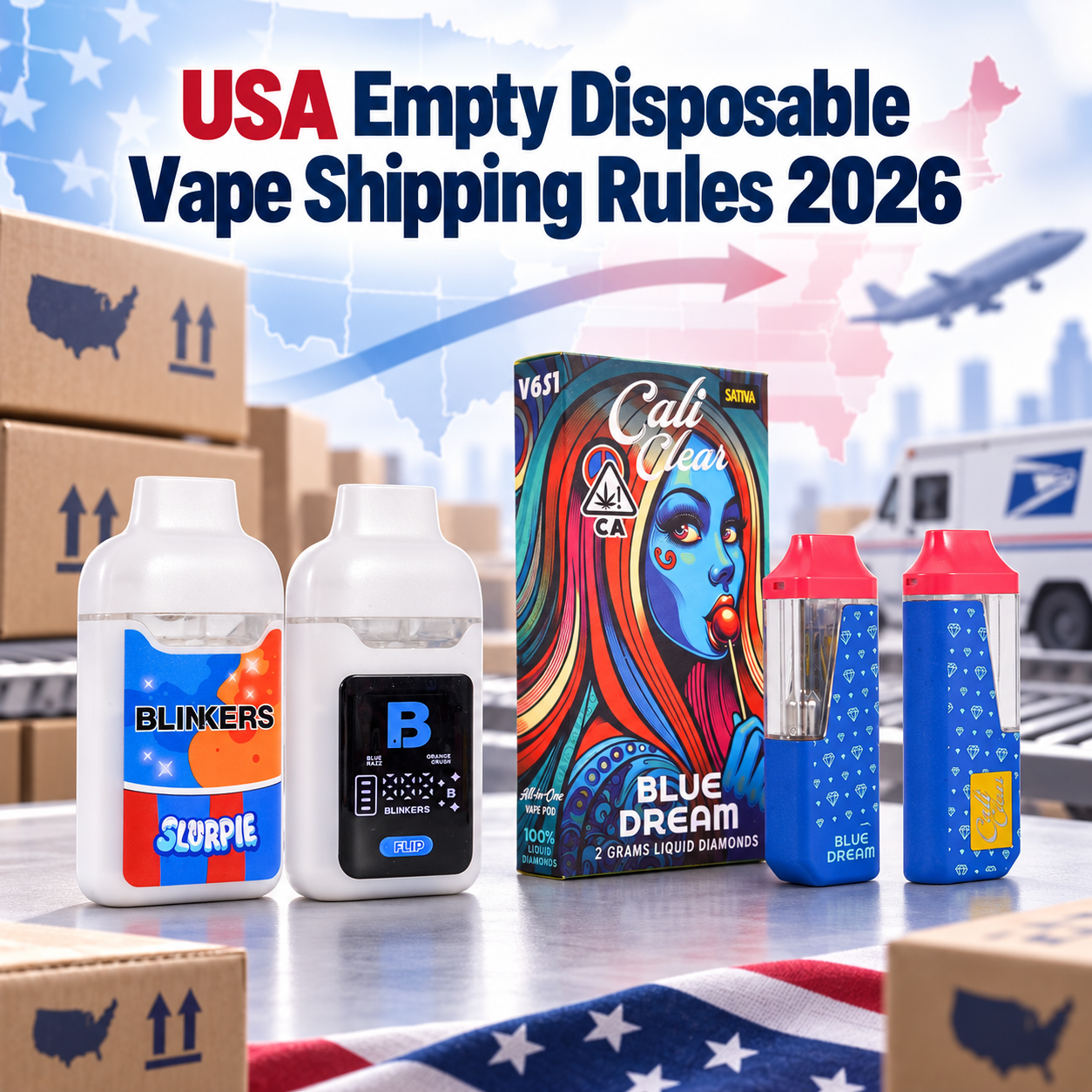
Shipping empty disposable vape hardware in the United States is not the same as shipping an ordinary consumer electronic product.
An empty device may contain no nicotine and no e-liquid, but that does not automatically remove it from U.S. vape-related rules.
Depending on the exact hardware, seller, buyer, origin and destination, a shipment may need to be reviewed under several separate systems:
PACT Act requirements;
USPS ENDS mailing restrictions;
private carrier policies;
lithium-battery transportation rules;
FDA tobacco-product and import requirements;
state and local rules.
These systems should not be treated as interchangeable.
A shipment can satisfy one requirement and still fail another.
For example, a business may be properly registered under the PACT Act but still be unable to use a carrier whose private policy prohibits vape products.
Likewise, a device may have appropriate lithium-battery documentation but still face FDA import issues.
For B2B wholesale buyers, the correct question is therefore not simply:
“Can this vape hardware be shipped?”
A better question is:
“Under which regulatory, carrier and battery pathway can this exact hardware move from this origin to this destination?”
This guide explains how to approach that question in 2026.
The Five-Layer U.S. Vape Hardware Shipping Model
Before choosing a carrier, separate the shipping problem into five layers.
Layer 1: Product Classification
What exactly is being shipped?
Is it:
a complete empty disposable device;
a battery-powered device;
a tank;
an atomizer;
a mouthpiece;
another component or part?
Layer 2: PACT / ENDS Requirements
Does the transaction involve a product covered by the federal ENDS definition?
Is the seller shipping covered products for profit in interstate commerce?
Layer 3: Carrier Acceptance
Even if the shipment is legally permissible, does USPS, UPS, FedEx or another carrier actually accept that product?
Layer 4: Lithium Battery Transportation
Does the device contain an installed lithium-ion battery?
If yes, what battery transport rules apply?
Layer 5: FDA, Import and Destination Rules
Is the product entering the United States from overseas?
Is it a regulated ENDS component or part?
What state or local rules apply at the destination?
This five-layer model is the foundation for the rest of the shipping decision.
Are Empty Disposable Vapes Considered ENDS?
One of the most common assumptions in empty vape hardware is:
“There is no nicotine inside, so PACT rules do not apply.”
That assumption can be wrong.
ATF currently explains that ENDS under the PACT Act include:
e-cigarettes;
vapes;
pods;
components;
liquids;
parts;
accessories of vaping devices.
ATF’s January 2026 FAQ specifically states that a component, liquid, part or accessory can fall within the ENDS definition regardless of whether it is sold separately from the device.
Therefore:
Empty does not automatically mean outside the ENDS framework.
A rechargeable empty disposable can still contain:
a tank;
ceramic heating element;
airflow sensor;
PCB;
mouthpiece;
lithium battery.
The exact classification should be based on the product and the specific rule being applied.
PACT Act and FDA Definitions Are Not Identical
Another reason this subject becomes confusing is that different agencies use different regulatory frameworks.
FDA currently states that it regulates ENDS components and parts, including examples such as:
cartridges;
atomizers;
certain batteries;
digital displays;
tank systems;
mouthpieces;
programmable software.
FDA separately excludes accessories from its ENDS component/part authority.
The PACT framework described by ATF, however, expressly includes components, parts and accessories.
That means a product should not be classified using one universal rule for every agency.
For B2B buyers:
PACT classification ≠ FDA classification ≠ carrier classification
Always identify which rule you are analyzing.
What Is the PACT Act?
The Prevent All Cigarette Trafficking Act, commonly called the PACT Act, was expanded in 2021 to cover ENDS.
ATF states that persons who sell, transfer or ship covered ENDS products for profit in interstate commerce can be required to register with ATF before conducting covered activities. Relevant state or local registration can also apply.
For empty vape hardware sellers, this matters because the law is not limited to bottles of nicotine e-liquid or finished nicotine disposables.
The ENDS definition can extend to hardware and components.
PACT Registration for B2B Vape Hardware Sellers
Suppose a U.S. wholesaler holds empty disposable vape hardware in a warehouse and ships orders to wholesale customers in multiple states.
The business should not assume:
“It is B2B, therefore PACT does not apply.”
ATF’s current guidance focuses on whether the business is selling, transferring or shipping covered products for profit in interstate commerce and the destination jurisdiction involved.
A relevant seller may need to consider:
federal ATF registration;
destination-state registration;
local registration;
tax obligations;
monthly reporting.
At the same time, ATF makes an important distinction for recipients.
A retailer that merely receives covered products from vendors and does not itself conduct the covered interstate sale, transfer, shipping or advertising activities does not need ATF registration merely because it receives inventory.
So:
shipping inventory and receiving inventory are not automatically treated the same.
PACT Monthly Reporting
PACT compliance can continue after the shipment leaves the warehouse.
ATF states that required registrants must provide reports to affected state and local governments by the 10th day of each calendar month covering relevant shipments made during the previous month.
The information can include:
customer name and address;
brand;
quantity;
delivery-company information.
That creates a useful distinction for B2B operators:
Shipment execution and shipment reporting are two different compliance tasks.
A company can successfully deliver packages and still have separate reporting obligations.
B2B Shipping Is Not the Same as B2C Delivery
Consumer delivery sales can create requirements involving matters such as:
age verification;
adult delivery procedures;
labeling;
tax and licensing requirements.
Wholesale B2B transactions can have a different operational structure.
However:
B2B does not automatically mean federally exempt.
For B2B sellers, the first questions should be:
Who is selling?
Who is receiving?
Where is the shipment going?
Is the product covered by the relevant ENDS definition?
Only after answering those questions should the carrier be selected.
Can USPS Ship Empty Vape Hardware?
The general USPS rule significantly restricts mailing ENDS.
However, USPS maintains specific exceptions.
The most relevant for B2B vape-hardware operations is the:
Business / Regulatory Purposes Exception
USPS Publication 52 states that this exception is available to qualifying legally operating businesses and government agencies.
Eligible business activities include:
manufacturing;
distribution;
wholesale;
export;
import;
testing;
investigation;
research.
That is important for the empty vape hardware industry.
But it does not mean every wholesale seller can immediately start mailing vape hardware through USPS.
The business must apply and establish eligibility.
USPS B2B ENDS Application
For ENDS, USPS currently requires applicants under the business/regulatory purposes exception to use:
PS Form 4615-E
and the applicable:
Worksheet 4615-EM
Worksheet 4615-ER
with supporting documentation.
USPS can request information regarding:
legal business status;
applicable licenses;
recipients;
authorized Post Office locations;
products being mailed.
For ENDS, USPS also asks for technical or safety documentation relating to hazardous materials such as lithium batteries where applicable.
Therefore:
B2B status alone is not the approval.
It is the basis on which an eligible business may seek the exception.
USPS Requirements After Approval
Approved business/regulatory shipments remain subject to detailed mailing procedures.
Current USPS Publication 52 requires qualifying shipments to use prepaid shipping labels and one of the permitted services:
Priority Mail Express;
Priority Mail;
USPS Ground Advantage.
USPS also requires Adult Signature or Adult Signature Restricted Delivery, a Domestic Return Receipt and specified package markings for these shipments. Sender and recipient information must match the authorized information on file.
The mailpiece must also be entered through an authorized acceptance location, and Publication 52 requires face-to-face tender to a Postal Service employee rather than ordinary package pickup or mailbox drop-off.
USPS added Ground Advantage to these exception pathways effective April 3, 2025.
This is a useful 2026 update because many older vape-shipping articles still describe USPS rules using outdated service information.
Can UPS Ship Empty Vape Hardware?
UPS currently takes a much stricter approach.
UPS states that it prohibits all Vaping Products throughout its U.S. domestic network, including import and export into or from the United States, regardless of nicotine content or destination state.
UPS defines Vaping Products broadly to include vaping devices and their:
components;
liquids;
gels;
parts;
accessories,
including where those items are sold separately.
UPS’s prohibited-items page also lists vape products within, to or from the United States as prohibited.
For empty hardware sellers, this creates a clear lesson:
Removing nicotine does not automatically make the product acceptable to UPS.
Can FedEx Ship Empty Vape Hardware?
FedEx also has a restrictive current policy.
Its official U.S. guidance states that tobacco and tobacco-product shipments are prohibited and specifically lists:
vaporizers;
e-cigarettes.
FedEx states that it will not accept the listed products even where the customer holds relevant licenses or authorization.
Again:
legal authorization is not the same as carrier acceptance.
2026 Carrier Matrix
Carrier
General 2026 Position for Vape/ENDS Hardware
USPS
Generally restricted; qualifying approved exceptions exist
UPS
U.S. vaping-product shipments prohibited under current policy
FedEx
Current policy prohibits listed vaporizer/e-cigarette shipments
Regional / specialist carrier
Must be verified directly
This table should be checked regularly.
Private carrier policies can change independently of federal law.
Why Carrier Policy Can Be Stricter Than the Law
This is one of the most important principles in vape logistics.
Consider two questions.
Is the Shipment Legally Permissible?
This can involve:
PACT Act;
state law;
FDA status;
battery regulations.
Will This Carrier Accept It?
This depends on the carrier’s private terms and operating policy.
A company could satisfy applicable registration requirements and still receive a carrier rejection.
Therefore:
Compliance does not create a right to use a particular carrier.
Always verify both layers.
Lithium Batteries Create a Separate Shipping Problem
An empty vape device may contain no liquid at all and still contain a rechargeable lithium-ion battery.
Lithium batteries are regulated hazardous materials for transportation purposes.
PHMSA regulates lithium batteries under the U.S. Hazardous Materials Regulations.
For a finished device whose installed lithium-ion battery provides power to that device, the shipment may fall within the UN3481 — Lithium ion batteries contained in equipment framework, depending on the exact configuration. PHMSA defines equipment as the device or apparatus powered by the battery.
Therefore:
empty vape ≠ no hazardous-materials considerations
because the battery remains.
Small Batteries Are Still Regulated Batteries
Many disposable-style devices use relatively small batteries.
That can create reduced requirements under certain conditions, but it does not mean the battery leaves the regulatory framework.
PHMSA’s current lithium-battery guide identifies specific requirements for smaller lithium-ion batteries contained in equipment under §173.185(c). It requires, among other things, protection against short circuit and packaging that prevents damaging movement.
Since May 10, 2024, lithium-ion batteries must also bear their Watt-hour rating on the outside case under the conditions described by PHMSA guidance.
For buyers:
“Small battery” should never be translated into “ordinary non-regulated parcel.”
What Battery Documents Should a Wholesale Buyer Request?
Before approving a rechargeable empty-vape shipment, collect battery information that corresponds to the actual production model.
A practical file may include:
battery manufacturer;
battery model;
nominal voltage;
mAh capacity;
Wh rating;
UN 38.3 documentation;
applicable test summary;
confirmation that the production battery matches the documented battery.
The important point is traceability.
A UN 38.3 document for one battery model does not automatically establish the transport status of a different battery substituted during production.
And:
UN 38.3 is evidence supporting battery transportation compliance—not a universal permission to ship vape hardware.
ENDS, carrier, FDA and destination rules still remain.
Ground vs Air Shipping
Battery requirements can change with transport mode.
Ground transport may provide different pathways for qualifying smaller lithium batteries.
Air transport can involve additional restrictions.
PHMSA guidance separates requirements for lithium batteries based on configuration, size and mode of transportation.
This is why a shipper should not assume:
“The product shipped successfully by ground, so the same carton can simply go by air.”
Transport mode should be part of the shipping approval process.
U.S. Warehouse Shipping vs China Factory Shipping
This is one of the most useful distinctions for empty vape hardware buyers.
Scenario A: USA Warehouse → USA B2B Buyer
The inventory has already entered the United States.
The main review can include:
Product classification
↓
PACT / state requirements
↓
Carrier acceptance
↓
Battery transport requirements
↓
Domestic delivery
International importation is no longer part of that particular buyer-to-warehouse shipment.
However, local stock does not automatically mean:
PACT exempt;
FDA authorized;
legal in every state;
accepted by every carrier.
Scenario B: China Factory → USA Buyer
This route adds another major layer:
Import Compliance
The process can include:
Product classification
↓
FDA product status
↓
Lithium battery export transport
↓
International carrier
↓
U.S. customs / FDA entry
↓
Domestic delivery
This is why asking:
“Can the factory ship it?”
does not answer the whole question.
A logistics provider may be able to physically transport the carton.
FDA may still have a separate view of whether the product can enter U.S. commerce.
FDA Rules for Empty Vape Components
FDA currently states that it regulates the manufacture, import, packaging, labeling, advertising, promotion, sale and distribution of ENDS, including regulated components and parts.
FDA’s examples include:
atomizers;
cartridges;
certain batteries;
tank systems;
mouthpieces;
digital displays.
Therefore:
An unfilled device is not automatically outside FDA tobacco-product regulation.
The exact result depends on the product’s characteristics and intended use.
FDA Import Alert 98-07: Important 2026 Update
This is one of the most important current developments for importers.
FDA updated Import Alert 98-07 on September 14, 2026.
The alert concerns ENDS lacking required premarket authorization and expressly states that, for purposes of the alert, ENDS include components and parts.
The alert describes circumstances in which covered products may face detention without physical examination, subject to FDA’s current procedures. It also references FDA’s May 2026 enforcement-priorities guidance.
For overseas hardware buyers, that means:
Carrier acceptance is not FDA market authorization.
A freight forwarder saying it can transport the cargo should not be treated as proof that FDA will permit the product to enter U.S. commerce.
State and Local Rules Still Matter
Federal rules are only part of the compliance picture.
ATF states that businesses can also need registration with states or localities into which covered products are shipped.
Depending on the destination, requirements can involve:
ENDS licensing;
registration;
taxes;
reporting;
delivery-sale restrictions;
product restrictions.
Therefore:
PACT registered ≠ approved for every state
and:
U.S. warehouse stock ≠ nationwide automatic availability
The destination should be checked before shipment.
A Practical B2B Shipping Decision Tree
A useful internal decision process for empty disposable vape hardware can look like this:
1. What exactly is the product?
↓
Complete empty device / component / part
↓
2. Does the relevant ENDS definition cover it?
↓
Yes / requires further classification
↓
3. Is the shipment domestic or imported?
↓
Domestic
Check:
PACT → state rules → carrier → battery
Imported
Check:
FDA/import status → international battery transport → customs/FDA entry → domestic carrier
↓
4. Does the device contain a lithium battery?
↓
If yes:
Confirm:
battery model → Wh → UN 38.3 → packaging → mode
↓
5. Which carrier is proposed?
↓
USPS → verify approved exception
UPS → current vaping prohibition
FedEx → current prohibition
Other carrier → verify written policy
↓
6. Is the destination permitted?
↓
Check federal + state/local requirements
↓
7. Are all records and documents matched to the actual SKU and batch?
↓
Only then approve the shipping pathway.
This decision tree is more useful than asking:
“Which vape shipping company should I use?”
because the answer depends on the product and transaction.
B2B Shipping Documentation Checklist
Before a wholesale shipment leaves the warehouse, build a documentation file for the exact model.
Check
What to Confirm
SKU / Model
Exact hardware configuration
Batch
Production / inventory batch
Shipping origin
U.S. warehouse or overseas
Destination
State and business address
Buyer type
Verified B2B recipient
ENDS assessment
Relevant federal classification
PACT status
Seller registration/reporting obligations
State status
Destination licensing/registration
Carrier
Current acceptance confirmed
USPS approval
Eligibility number and authorized parties if used
Battery model
Exact cell installed
Battery capacity
mAh and Wh
UN 38.3
Documentation matches battery
Transport mode
Ground or air
FDA/import status
Required if entering United States
Shipment records
Invoice / reporting information retained
This is where good logistics and good QC intersect.
The shipment documentation should correspond to the actual production hardware, not a similar historical model.
Empty Hardware vs Filled Vape Products
Being empty can remove certain liquid-related considerations, but it does not necessarily remove ENDS or battery requirements.
Issue
Empty Hardware
Filled Product
PACT assessment
Can apply
Can apply
USPS restrictions
Can apply
Can apply
Carrier restriction
Often applies
Often applies
Lithium battery
Applies if installed
Applies if installed
E-liquid transport
Generally absent
Additional assessment
FDA regulation
Components/parts can be regulated
Finished ENDS can be regulated
State rules
Must check
Must check
The practical conclusion is:
Empty hardware can simplify part of the shipment, but “empty” should never be treated as a universal shipping exemption.
Common Shipping Mistakes
Mistake 1: “There Is No Nicotine, So It Is Not ENDS”
PACT definitions can include the device and related components, parts and accessories.
Mistake 2: “It Is B2B, So PACT Does Not Apply”
B2B status changes some operational issues but does not automatically remove PACT registration and reporting questions.
Mistake 3: “USPS Bans Everything”
USPS generally restricts ENDS but maintains specific exceptions, including an approval-based business/regulatory purposes pathway.
Mistake 4: “We Are a Wholesaler, So We Can Use the USPS Exception”
Eligibility must be established and approved.
Mistake 5: “We Are PACT Compliant, So UPS Should Accept It”
UPS’s current U.S. policy separately prohibits vaping products.
Mistake 6: “FedEx Will Take It If We Have a License”
FedEx’s current policy states otherwise for the listed vaporizer/e-cigarette category.
Mistake 7: “The Vape Is Empty, So There Is No Dangerous Goods Issue”
An installed lithium-ion battery creates a separate transportation analysis.
Mistake 8: “We Have UN 38.3, So the Shipment Is Approved”
UN 38.3 does not replace carrier, PACT, FDA or state compliance.
Mistake 9: “The Freight Forwarder Accepted It, So FDA Is Fine”
Transport acceptance is not FDA authorization.
Mistake 10: “It Is in a U.S. Warehouse, So It Can Ship Nationwide”
Domestic inventory can still be subject to PACT, carrier, battery and state requirements.
Questions to Ask Your Vape Hardware Supplier
Before approving a U.S. order, ask the supplier:
1. Where is this exact inventory located?
U.S. warehouse and factory-direct shipments follow different logistics paths.
2. What is the exact product model?
Shipping documents should match the actual hardware.
3. Does the product contain an installed lithium-ion battery?
If yes, obtain the exact battery specification.
4. What are the battery’s mAh and Wh ratings?
These are useful transport specifications.
5. Does the UN 38.3 documentation match the production battery?
Do not accept documentation for a different cell.
6. Which carrier will physically handle the shipment?
“U.S. delivery” is not enough information.
7. Has the carrier confirmed acceptance of this exact product category?
Carrier policies can be stricter than federal law.
8. If USPS is used, is the shipment moving under an approved exception?
Ask who holds the eligibility and whether sender, recipient and entry location are authorized.
9. If shipping from overseas, what FDA/import pathway has been reviewed?
International shipping and FDA admissibility are separate issues.
10. Who handles PACT registration and monthly reporting?
Define responsibilities before shipping.
11. Who verifies destination-state rules?
Do not leave this question until the package is ready.
12. What is the backup shipping plan if the selected pathway becomes unavailable?
Carrier policies can change.
Frequently Asked Questions
Can Empty Disposable Vape Hardware Be Shipped in the USA?
Potentially, but the answer depends on the exact product and transaction.
You need to consider:
ENDS classification + PACT + carrier + battery + FDA + destination state
rather than relying on one rule.
Does the PACT Act Apply to Empty Vape Devices?
It can.
ATF’s current PACT Act guidance includes vaping-device components, parts and accessories within the ENDS framework.
Can USPS Ship Empty Vape Hardware?
USPS generally restricts ENDS mailing, but qualifying businesses can apply for the business/regulatory purposes exception.
Approval and detailed mailing conditions apply.
Can Wholesale Businesses Use USPS Ground Advantage?
Qualifying approved business/regulatory exception shipments can currently use USPS Ground Advantage, Priority Mail or Priority Mail Express.
Ground Advantage was added to the exception framework effective April 3, 2025.
Can I Drop an Approved B2B Vape Package in a USPS Collection Box?
No under the cited business/regulatory exception procedures.
USPS requires covered exception shipments to be tendered face-to-face at an authorized Postal Service acceptance location.
Does UPS Ship Empty Vape Hardware?
UPS’s current U.S. policy prohibits vaping products throughout its U.S. domestic network, including covered import/export movements, regardless of nicotine content.
Does FedEx Ship Empty Vape Hardware?
FedEx’s current guidance prohibits the listed tobacco, vaporizer and e-cigarette category.
Is an Empty Vape With a Battery a Lithium-Battery Shipment?
The installed lithium-ion battery can bring the device within applicable lithium-battery transportation rules.
A finished device powered by an installed lithium-ion battery may be classified under UN3481 depending on the configuration.
Is UN 38.3 Enough?
No.
It addresses battery testing but does not replace:
PACT;
USPS rules;
carrier policy;
FDA requirements;
state law.
Does FDA Regulate Empty Vape Hardware?
FDA regulates ENDS components and parts that fall within its authority and specifically lists examples such as atomizers, certain batteries, tanks and mouthpieces.
Can Empty Vape Hardware Be Imported Directly From China?
Importation creates additional FDA and international-transport questions.
FDA’s Import Alert 98-07, updated September 14, 2026, covers unauthorized ENDS including components and parts and describes potential detention without physical examination.
Is Shipping From a U.S. Warehouse Easier?
It removes the new international import stage from that domestic order, which can simplify logistics.
However, domestic PACT, carrier, battery and state rules can still apply.
Can a U.S. Warehouse Ship to All 50 States?
Do not assume so.
State and local licensing, tax, delivery and product requirements need to be checked for the destination.
Final Thoughts
U.S. empty vape hardware shipping is not a single-rule problem.
A reliable decision process looks like this:
Identify the Exact Product
↓
Determine the Relevant ENDS Classification
↓
Review PACT Obligations
↓
Check State and Local Requirements
↓
Verify Carrier Acceptance
↓
Review Lithium Battery Requirements
↓
If Imported, Review FDA Status
↓
Match Documents to the Exact SKU and Batch
↓
Approve the Shipping Path
The most important lesson for B2B buyers is that several statements can be true at the same time.
A device can be:
empty
and still fall within an ENDS definition.
A business can be:
PACT registered
and still be rejected by UPS.
A battery can have:
UN 38.3 documentation
and the finished product can still face FDA import problems.
And inventory can already be:
inside a U.S. warehouse
while destination-state and carrier requirements still remain.
That is why a strong wholesale shipping process should never begin with:
“Which carrier is cheapest?”
It should begin with:
“What is the exact product, where is it now, where is it going, who is receiving it, and which regulatory and carrier pathway applies?”
Once those questions are documented, shipping becomes a structured compliance decision rather than a last-minute logistics problem.
Regulatory Disclaimer: This guide provides general B2B regulatory and logistics information based on publicly available federal agency and carrier guidance current as of September 2026. It does not constitute legal, tax, customs, FDA, PACT Act or hazardous-materials transportation advice. Federal, state, local and carrier requirements may change. Verify the rules applicable to the exact product, transaction, origin and destination before shipping.
Hello, please contact us if you have any questions! Whatsapp : +1-713-363-1015 Telegram : @Amy99812 Email : chengstella120@gmail.com iMessage: +1-713-363-1015
We have received your message and we will contact you as soon as possible!