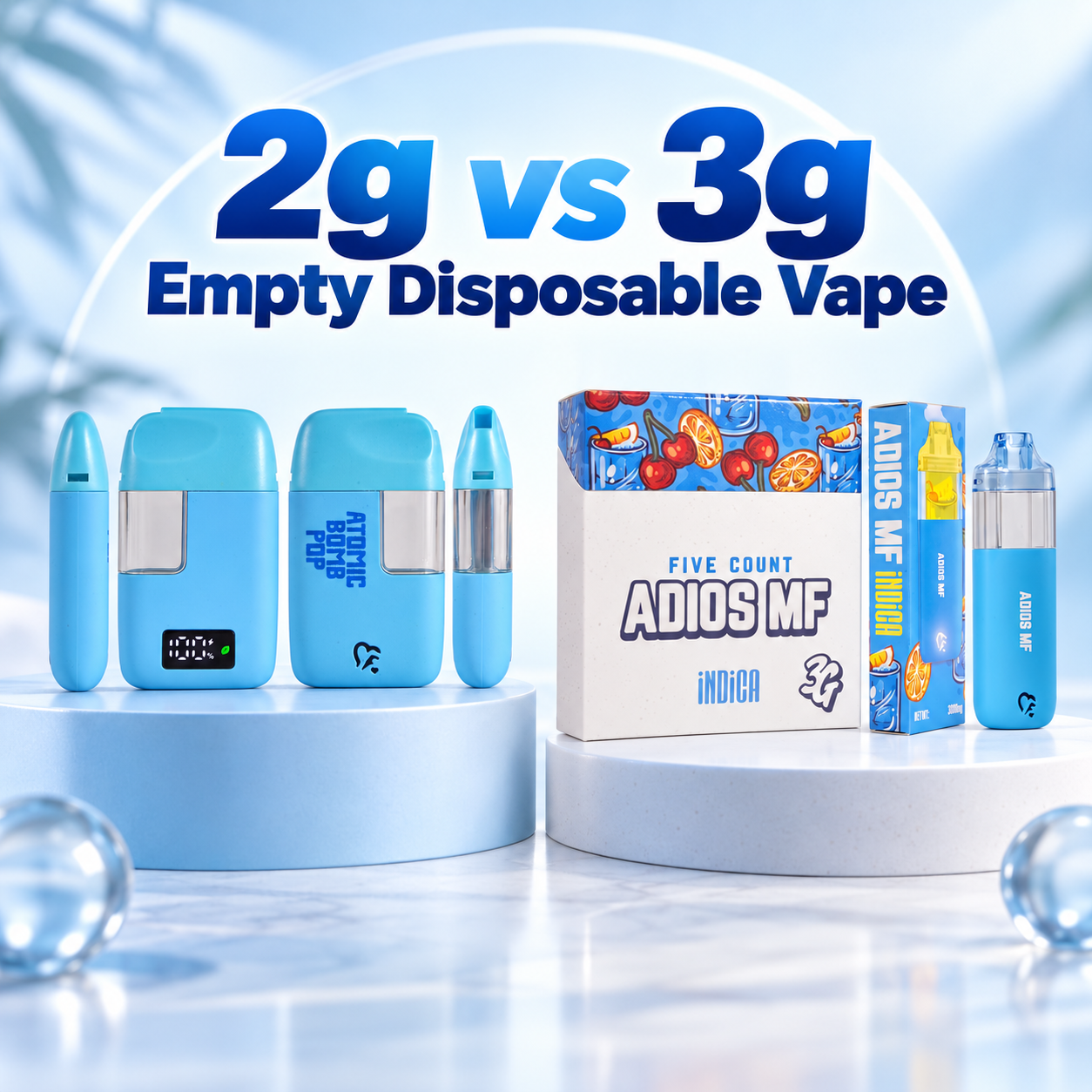
When wholesale buyers compare 2g and 3g empty disposable vape , capacity is usually the first specification they notice.
But capacity alone does not tell you which device is better for a particular project.
Battery size, resistance, heating structure, operating voltage, filling-port dimensions, charging system and physical design can all affect how a device performs during filling, testing and mass production.
There is also another important issue that B2B buyers should understand:
The capacity printed on the packaging is not always the same as the actual tank capacity of the hardware.
The Favorites 3g, for example, is labeled as a 3 ml product on the packaging, while its actual tank capacity is 2.3 ml.
The Favorite Mini 2g, by comparison, has an actual tank capacity of 2.0 ml.
That means the practical capacity difference between these two products is not 1 ml.
It is 0.3 ml.
To make this comparison more useful for wholesale buyers, we are therefore not looking only at generic “2g vs 3g” product names.
In this guide, we compare two actual hardware configurations:
Favorite Mini 2g
Favorites 3g
The goal is not to declare that 2g or 3g is universally better.
Instead, we want to show how marketed capacity, actual tank volume, battery, resistance, heating structure and filling requirements can differ—and why buyers should evaluate the complete hardware system before placing a bulk order.
Favorites 3g vs Favorite Mini 2g: Specification Comparison
Here are the current specifications for the two models.
Specification
Favorite Mini 2g
Favorites 3g
Packaging / Marketed Capacity
2 ml
3 ml
Actual Tank Capacity
2.0 ml
2.3 ml
Battery Capacity
300 mAh
280 mAh
Resistance
1.4 Ω
1.8 Ω
Heating Technology
Preheating ceramic coil
Output Voltage
3.15 V
Charging Port
USB Type-C
USB Type-C
Activation
Draw activated
Filling Port
Max. 2.0 mm
Heating Element Size
8 × 4.3 × 4.3
Color Options
10 flavor colors
20 shell colors
Printing
One-sided flavor printing
This table immediately reveals an important point:
The Favorites 3g is not simply a Favorite Mini 2g with one extra milliliter of usable tank space.
Although the packaging positions the product as 3 ml, the actual tank capacity is 2.3 ml.
That means its usable capacity is only 0.3 ml larger than the 2.0 ml Favorite Mini 2g.
At the same time, the two products use different:
battery capacities;
resistance values;
exterior configurations;
potentially different heating architectures.
They should therefore be treated as two separate hardware systems during sample approval and bulk-production testing.
What Does 2g or 3g Actually Mean?
Product names such as “2g” and “3g” can be useful for market positioning, but wholesale buyers should not assume that the number on the product name or packaging always equals the actual internal tank capacity.
There are two different concepts to understand.
Packaging / Marketed Capacity
This is the capacity used to position or identify the product in the market.
For example:
Favorite Mini 2g: 2 ml
Favorites 3g: 3 ml labeled on packaging
Actual Tank Capacity
This is the physical liquid capacity of the tank itself.
For these two models:
Favorite Mini 2g: 2.0 ml actual capacity
Favorites 3g: 2.3 ml actual capacity
This creates an important distinction.
Model
Marketed Capacity
Actual Tank Capacity
Favorite Mini 2g
2 ml
2.0 ml
Favorites 3g
3 ml
2.3 ml
The Favorites 3g is therefore marketed as a 3 ml-class product, but its actual tank volume is 2.3 ml.
For B2B buyers, actual tank capacity matters when calculating:
filling volume;
formulation cost;
filling time;
production output;
finished-product inventory value.
This is why buyers should ask suppliers for both:
marketed capacity + actual tank capacity
instead of relying on the model name alone.
1. Actual Capacity: 2.0 ml vs 2.3 ml
Once actual capacity is considered, the difference between these two devices becomes much smaller than the product names suggest.
The Favorite Mini 2g has:
2.0 ml actual tank capacity
The Favorites 3g has:
2.3 ml actual tank capacity
The difference is therefore:
0.3 ml
rather than 1 ml.
That matters commercially.
A buyer looking only at “2g vs 3g” might assume the Favorites 3g provides approximately 50% more usable capacity.
Based on the actual tank specifications, that would not be accurate.
Its actual capacity is only about 15% larger than the 2.0 ml Favorite Mini.
This is exactly why procurement decisions should be based on technical specifications rather than packaging labels alone.
2. Why Marketed Capacity and Actual Capacity Matter
The distinction affects several parts of the supply chain.
Filling Cost
If you calculate formulation cost using 3 ml instead of the actual 2.3 ml tank capacity, your cost model will be inaccurate.
Production Planning
Actual fill volume affects:
filling-machine settings;
total formulation required;
cycle time;
batch planning.
Product Comparison
A buyer may compare two devices assuming:
2 ml vs 3 ml
when the real hardware comparison is:
2.0 ml vs 2.3 ml
Those are very different commercial decisions.
Customer Expectations
Capacity claims should also be reviewed carefully when preparing packaging and product descriptions for a particular market.
From a procurement perspective, the safest approach is to maintain an internal specification that clearly identifies:
packaging capacity;
actual tank capacity;
validated production fill amount.
These should not automatically be treated as the same number.
3. Battery Capacity: The Smaller Device Has the Larger Battery
This is another interesting difference between the two products.
The Favorite Mini 2g uses a 300 mAh battery.
The Favorites 3g uses a 280 mAh battery.
Model
Actual Tank Capacity
Battery
Favorite Mini 2g
2.0 ml
300 mAh
Favorites 3g
2.3 ml
280 mAh
A buyer might expect the product marketed as the larger-capacity device to automatically use the larger battery.
These specifications show that this assumption is not always correct.
However, battery capacity alone does not determine overall battery performance.
It must be evaluated together with:
resistance;
output voltage;
heating-element design;
power-management logic;
expected activation cycle.
The correct question is:
How well is the battery matched to the heating system and actual tank capacity?
4. Resistance: 1.4 Ω vs 1.8 Ω
The two devices also use different resistance specifications.
Favorite Mini 2g: 1.4 Ω
Favorites 3g: 1.8 Ω
This is a meaningful engineering difference.
Resistance influences electrical behavior together with:
output voltage;
heating material;
coil structure;
airflow;
formulation.
The Favorite Mini 2g uses a preheating ceramic coil at 1.4 Ω.
The Favorites 3g is specified at 1.8 Ω with an output voltage of 3.15 V.
That means the two products should not be treated as identical platforms with different tank sizes.
They use different electrical configurations.
5. Heating Technology
The Favorite Mini 2g uses a preheating ceramic coil.
Its heating-element size is listed as:
8 × 4.3 × 4.3
For B2B buyers, ceramic heating should still be evaluated using actual performance rather than the word “ceramic” alone.
Important factors include:
heating consistency;
liquid inlet design;
resistance;
airflow;
formulation compatibility.
For the Favorites 3g, the exact heating structure should be confirmed and added to the final technical file.
Once confirmed, buyers can compare whether differences in:
resistance;
ceramic design;
heating surface;
inlet structure
help explain differences in performance between the two devices.
6. Output Voltage
The Favorites 3g has a listed output voltage of:
3.15 V
Combined with its:
1.8 Ω resistance
this provides useful information about the electrical architecture.
The Favorite Mini 2g currently has a confirmed resistance of:
1.4 Ω
but its output voltage should also be documented for a complete side-by-side comparison.
This reinforces an important point:
Capacity cannot be evaluated separately from battery, resistance and output voltage.
Two devices with similar actual tank volumes can still behave very differently because of their electrical design.
7. Filling Port and Filling-Line Compatibility
The Favorite Mini 2g has a listed maximum filling-port size of:
2.0 mm
This is a useful production specification.
It directly affects compatibility with:
filling needles;
automated equipment;
semi-automatic filling machines;
production fixtures.
Buyers should confirm:
needle diameter;
needle depth;
filling position;
fill speed;
fixture compatibility.
The Favorites 3g filling-port dimension should also be recorded.
Even though the actual capacity difference is only 0.3 ml, the physical chamber and filling opening may still be different.
Therefore:
Do not assume the same filling setup can automatically be used for both models.
8. Filling Volume and Production Efficiency
The actual tank-capacity data changes the filling comparison significantly.
Instead of comparing:
2 ml vs 3 ml
the real tank comparison is:
2.0 ml vs 2.3 ml
That means the difference in material volume per device is relatively modest.
However, actual production efficiency still depends on:
target fill amount;
formulation viscosity;
filling equipment;
filling-port size;
pump settings.
A useful production comparison would record:
Test
Favorite Mini 2g
Favorites 3g
Actual tank capacity
2.0 ml
2.3 ml
Production fill amount
[Actual test]
[Actual test]
Average filling time
[Actual test]
[Actual test]
Needle size
[Actual test]
[Actual test]
Capping time
[Actual test]
[Actual test]
This data will be far more useful to a wholesale buyer than simply comparing “2g vs 3g.”
9. Formulation Compatibility
The same formulation should be evaluated separately in both devices.
The hardware differs in:
actual tank capacity;
battery capacity;
resistance;
heating configuration.
The specifications currently show:
Favorite Mini 2g
2.0 ml actual capacity
300 mAh battery
1.4 Ω resistance
preheating ceramic coil
Favorites 3g
2.3 ml actual capacity
280 mAh battery
1.8 Ω resistance
3.15 V output
Even though the capacity difference is only 0.3 ml, these electrical differences mean the devices are not interchangeable from a testing perspective.
Therefore:
A formulation that performs well in the Favorite Mini 2g should still be validated separately in the Favorites 3g.
10. Leakage and Storage Testing
Does the Favorites 3g automatically have a higher leakage risk because it is marketed as 3g?
No.
The actual capacity difference is relatively small:
2.0 ml vs 2.3 ml
Leakage depends much more on factors such as:
chamber geometry;
sealing;
component tolerance;
formulation viscosity;
fill amount;
capping;
temperature;
storage orientation.
Both models should therefore undergo the same controlled test method.
The important rule is:
Compare both models under the same conditions.
11. Airflow and Activation
The Favorite Mini 2g uses:
draw activation
This means airflow and sensor performance directly influence activation.
Buyers should check:
draw resistance;
activation delay;
sensor consistency;
abnormal airflow noise;
blocked airflow.
For the Favorites 3g, the activation method should be confirmed.
If it is also draw activated, both products can be compared side by side under the same airflow test conditions.
Capacity alone does not determine airflow performance.
Internal structure matters more.
12. Charging: Both Use USB Type-C
Both devices use:
USB Type-C charging
That creates one obvious similarity.
However, the battery capacities differ:
Favorite Mini 2g: 300 mAh
Favorites 3g: 280 mAh
Actual charging performance should therefore be tested rather than assumed.
Useful data includes:
charging initiation;
average charging time;
charging completion;
connector stability;
abnormal heating.
The Favorite Mini has the larger listed battery even though it is the smaller-capacity device.
That makes charging data particularly useful for this comparison.
13. Color and Branding Options
The two devices also differ in exterior options.
Favorite Mini 2g
The current specification lists:
10 flavor-color options
This can support visual differentiation between product variants.
Favorites 3g
The specification lists:
20 shell colors
plus:
one-sided printed flavor identification
This gives buyers more exterior color choices and additional printed flavor differentiation.
For B2B buyers, this affects:
SKU planning;
packaging coordination;
inventory management;
private-label branding.
More color choices increase customization flexibility.
They can also increase inventory complexity.
14. Cost and Inventory Exposure
The actual capacity data also changes how buyers should think about cost.
If the Favorites 3g were actually a full 3 ml tank, it would contain 50% more liquid than a 2 ml device.
But its actual tank capacity is:
2.3 ml
That is only:
0.3 ml more
than the Favorite Mini 2g.
This means formulation-cost differences may be smaller than the packaging names suggest.
Buyers should calculate finished-product cost using:
actual production fill volume
rather than the marketed capacity printed on the box.
A useful commercial calculation should include:
empty hardware cost;
actual formulation volume;
packaging;
labor;
freight;
inventory financing.
This gives a more accurate comparison of finished-unit economics.
15. Packaging and Shipping
The packaging distinction is especially relevant in this comparison because the Favorites 3g is labeled as 3 ml even though the actual tank capacity is 2.3 ml.
For wholesale buyers, packaging should therefore be reviewed separately from internal hardware specifications.
Useful logistics data includes:
device dimensions;
empty device weight;
individual box size;
master-carton quantity;
carton dimensions;
carton gross weight.
The Favorites 3g may still be physically larger than the Favorite Mini 2g despite only having 0.3 ml more actual tank capacity.
If so, that can influence:
units per carton;
freight efficiency;
warehouse density;
fulfillment cost.
This is why actual device dimensions should be added to the comparison.
16. Which Model May Be Better for a New Product Project?
The Favorite Mini 2g may fit projects prioritizing:
2.0 ml actual tank capacity;
300 mAh battery;
1.4 Ω resistance;
preheating ceramic coil;
maximum 2.0 mm filling port;
10 flavor-color options.
The Favorites 3g may fit projects prioritizing:
3 ml market positioning;
2.3 ml actual tank capacity;
280 mAh battery;
1.8 Ω resistance;
3.15 V output;
20 shell colors;
one-sided printed flavor identification.
The most important commercial difference is that the Favorites 3g offers stronger 3 ml-class product positioning, but its actual tank capacity is only moderately larger.
Whether that positioning is valuable depends on the target market.
17. How We Recommend Comparing These Two Models
The strongest B2B comparison is based on the same test conditions.
Use the same:
formulation;
filling machine;
filling operator;
storage environment;
observation period;
charging equipment.
Then record:
Test
Favorite Mini 2g
Favorites 3g
Marketed capacity
2 ml
3 ml
Actual tank capacity
2.0 ml
2.3 ml
Battery
300 mAh
280 mAh
Resistance
1.4 Ω
1.8 Ω
Output
[Confirm]
3.15 V
Heating
Preheating ceramic
[Confirm]
Charging
Type-C
Type-C
Filling port
Max. 2.0 mm
[Confirm]
Color options
10
20
Device dimensions
[Test]
[Test]
Empty weight
[Test]
[Test]
Production fill amount
[Test]
[Test]
Average filling time
[Test]
[Test]
Charging time
[Test]
[Test]
Leakage result
[Test]
[Test]
Airflow result
[Test]
[Test]
Units per carton
[Confirm]
[Confirm]
This table turns a generic “2g vs 3g” article into a real procurement comparison.
Questions to Ask Before Choosing Between the Two
Before placing a bulk order, ask:
1. What is the actual tank capacity?
For these products:
Favorite Mini 2g: 2.0 ml
Favorites 3g: 2.3 ml
Do not rely only on the packaging label.
2. What is the recommended production fill amount?
Actual physical tank capacity and recommended production fill settings may still differ.
3. What heating technology does the Favorites 3g use?
This should be confirmed for a complete comparison.
4. What is the output voltage of Favorite Mini 2g?
This will allow a more complete electrical comparison.
5. Is Favorites 3g draw activated?
Confirm the activation architecture.
6. What is the filling-port size of Favorites 3g?
Important for filling-line compatibility.
7. Can the same formulation be used in both devices?
Test rather than assume.
8. Can both products use the same filling fixture?
Confirm dimensions first.
9. What leakage test is used for each model?
Compare under identical test conditions.
10. What are the packaging and MOQ differences?
These can influence the commercial decision as much as hardware specifications.
Common Buyer Mistakes
Mistake 1: Assuming 3g Means 3 ml Actual Capacity
The Favorites 3g is labeled as 3 ml, but its actual tank capacity is 2.3 ml.
Always confirm actual hardware capacity.
Mistake 2: Assuming the Capacity Difference Is 1 ml
In this case, the real difference is only:
0.3 ml
Mistake 3: Assuming the 3g Model Must Have a Larger Battery
The Favorite Mini 2g uses 300 mAh, while the Favorites 3g uses 280 mAh.
Mistake 4: Comparing Only Capacity
Resistance, voltage, heating technology and filling design also matter.
Mistake 5: Using Marketed Capacity to Calculate Filling Cost
Use actual production fill volume instead.
Mistake 6: Assuming the Same Formulation Performs Identically
Different electrical systems should be validated separately.
Mistake 7: Ignoring Packaging and Logistics
The device marketed as 3g may still have different physical dimensions and carton density.
Mistake 8: Choosing the Product Name Instead of the Hardware System
A bigger number on the package does not automatically mean a better B2B product.
Favorite Mini 2g vs Favorites 3g: Which Should You Choose?
Hello, please contact us if you have any questions! Whatsapp : +1-713-363-1015 Telegram : @Amy99812 Email : chengstella120@gmail.com iMessage: +1-713-363-1015
We have received your message and we will contact you as soon as possible!