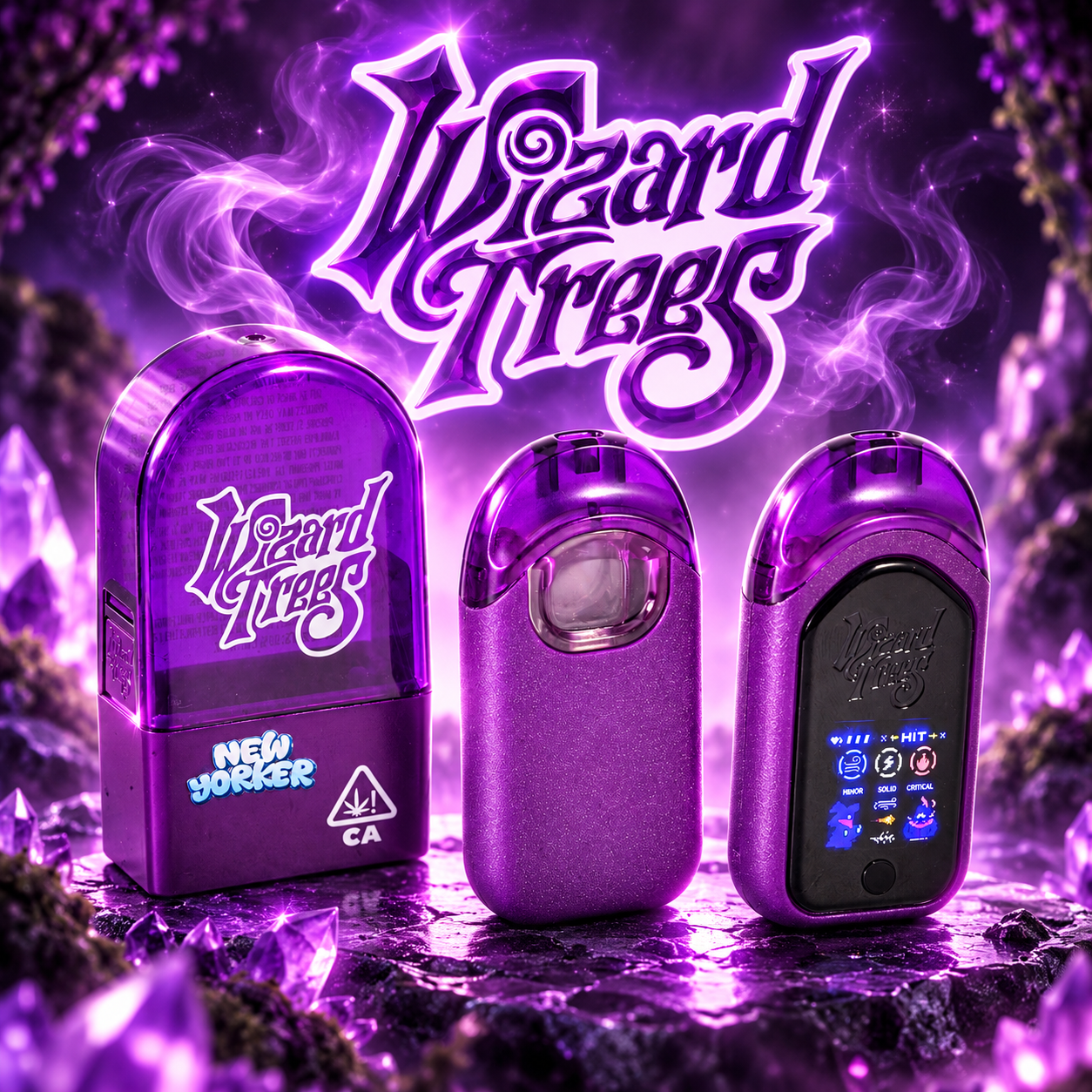
Wizard Trees is a Los Angeles-based cannabis brand recognized for its focus on cultivation, distinctive genetics, and product identity. Originating in California’s cannabis industry, the brand has developed an identity centered on specialized breeding and flower quality.
As interest in the brand has expanded, the Wizard Trees name has also appeared in discussions of disposable vape devices, including single-chamber and dual-chamber hardware configurations.
However, understanding Wizard Trees vape hardware requires an important distinction: a device featuring a brand name is not necessarily manufactured, distributed, or officially authorized by that brand.
For anyone researching Wizard Trees disposable vape devices, understanding the differences between brand identity, hardware design, product specifications, and safety documentation is essential.
This guide explores the background of Wizard Trees, explains common 1G and 2G disposable hardware configurations, examines dual-chamber technology, and highlights important technical and regulatory considerations.
1. What Is Wizard Trees? Understanding the Brand
Wizard Trees is a cannabis brand based in Los Angeles, California, with a background in premium flower cultivation and cannabis genetics.
According to its official website, the company began as a flower-focused brand before expanding its work into developing distinctive cannabis genetics.
This evolution led to Wizard Trees Genetics, which emphasizes breeding and the development of proprietary genetic varieties.
From Cannabis Cultivation to Genetics
Cannabis genetics involves the development and selection of plant varieties with particular characteristics.
Breeding programs may focus on traits such as:
Plant growth characteristics
Aroma and terpene profiles
Flower structure and appearance
Genetic consistency
Cultivation performance
The official Wizard Trees brand emphasizes its breeding expertise and the development of distinctive cannabis varieties.
This background is central to understanding the brand’s identity.
Rather than defining Wizard Trees only through disposable vape products, it is more accurate to recognize its origins in cannabis cultivation and genetics.
Wizard Trees and Brand Recognition
The Wizard Trees name has become associated with California cannabis culture and distinctive product branding.
However, brand recognition and product authenticity are separate matters.
A product featuring recognizable colors, logos, or packaging does not automatically establish that it originated from the official brand.
This is particularly important when evaluating electronic devices sold through third-party websites or distributors.
A disposable vape is an electronic device containing components designed to store and deliver electrical energy to a heating system.
Depending on the design, it may include a rechargeable battery, integrated reservoir, heating component, airflow channel, and electronic control circuitry.
The phrase Wizard Trees disposable vape may refer to devices marketed using Wizard Trees-related branding.
However, products carrying similar branding can differ in their manufacturing origin, internal construction, electrical specifications, and regulatory status.
What Is Empty Disposable Vape Hardware?
Empty disposable vape hardware generally refers to a disposable-style device supplied without pre-filled vaping liquid.
A typical device may contain:
An integrated lithium-ion battery
A heating element
A liquid reservoir
An airflow system
A printed circuit board (PCB)
An activation mechanism
A charging port, where applicable
An external housing and mouthpiece
The exact components depend on the specific product design.
Empty hardware should not be confused with a finished, pre-filled cannabis or nicotine product.
The presence or absence of liquid can also affect the applicable product classification and regulatory requirements.
Why Hardware Specifications Matter
Two devices that look nearly identical may have different electrical and mechanical designs.
For example, they may use different:
Battery capacities
Coil resistance values
Charging controllers
Heating materials
Reservoir structures
Airflow arrangements
Sealing components
These differences can influence how the device is evaluated for electrical safety, mechanical integrity, and manufacturing consistency.
Understanding actual technical specifications is therefore more useful than relying solely on a product name or exterior appearance.
Some feature a single larger reservoir, while others use dual-chamber architecture.
This distinction matters because the nominal capacity alone does not reveal the internal construction.
A larger-format device may introduce additional considerations related to reservoir geometry, heating system requirements, battery demand, and overall component arrangement.
The appropriate evaluation depends on the exact hardware design.
1G vs 2G Hardware Comparison
Feature
1G Single-Chamber Format
2G Dual-Chamber Format
Nominal format
1G
2G
Reservoir architecture
Typically one reservoir
Typically two separate reservoirs
Internal structure
Generally simpler
Often more complex
Heating components
Commonly one heating system
May use separate heating systems
Airflow arrangement
Often a single airflow path
May use shared or separate paths
Electronic controls
May be relatively simple
May require additional control logic
Sealing interfaces
Generally fewer
Potentially more
Quality-control considerations
Sealing, electrical function, assembly
Multi-chamber sealing, control logic, assembly
This table illustrates general design differences. It does not represent verified specifications for every device carrying Wizard Trees-related branding.
4. Wizard Trees Duo and Dual-Chamber Technology Explained
The term Wizard Trees Duo appears in discussions and product listings involving dual-chamber disposable vape hardware.
A dual-chamber device generally incorporates two separate reservoirs within a single outer housing.
However, dual-chamber designs are not standardized across all manufacturers.
Two devices described using the same terminology may have very different internal architectures.
How Does Dual-Chamber Hardware Work?
A dual-chamber device may contain two separate reservoir systems connected to independent or shared electronic components.
Depending on the specific design, the system may incorporate:
Two reservoirs
Separate heating elements
Shared battery power
Independent electrical pathways
Chamber selection controls
Shared or independent airflow channels
Some devices include electronic controls for selecting between chambers.
Others use different mechanical or airflow arrangements.
The exact design must be verified from the manufacturer’s technical documentation.
Airflow and Heating System Design
Airflow is an important part of the overall device architecture.
A single-chamber device typically has a relatively straightforward relationship between its reservoir, heating structure, and air channel.
Dual-chamber devices may require more complex airflow routing and component integration.
Engineering considerations can include internal alignment, sealing locations, electrical connections, and the interaction between the heating system and control circuitry.
A more complex design is not automatically more effective or safer.
Sealing and Structural Considerations
Multiple reservoirs may introduce additional sealing interfaces.
Each interface represents a location where component fit, dimensional tolerances, and assembly consistency matter.
Potential problems may include:
Misaligned components
Damaged seals
Inconsistent reservoir dimensions
Internal liquid migration
Housing deformation
Assembly variation
These problems cannot be evaluated reliably from product appearance alone.
Quality evaluation for a dual-chamber device may require examining more than the external housing.
Relevant inspection areas include:
Reservoir integrity
Internal sealing interfaces
Electrical connection quality
Heating system consistency
Control-board behavior
Charging functionality
Mechanical assembly
The test plan should reflect the actual device design rather than relying on the label “dual chamber.”
5. Battery, Charging, and Electrical Safety Considerations
Battery safety is one of the most important technical subjects associated with rechargeable disposable vape hardware.
Most compact rechargeable designs use lithium-ion battery technology.
These cells provide high energy density, but they also require appropriate charging management, electrical protection, and mechanical integration.
Battery Capacity and Electrical Load
Battery capacity is commonly expressed in milliampere-hours (mAh).
This value provides information about rated charge capacity, but it does not establish overall device safety or performance by itself.
Actual electrical behavior depends on several factors, including:
Cell characteristics
Heating element resistance
Operating voltage
Current demand
Charging circuitry
Protection features
Temperature conditions
A higher battery capacity does not necessarily indicate a better-designed device.
Charging System Design
Rechargeable devices may feature USB-C charging interfaces.
However, the connector type alone does not determine charging safety.
The internal charging management circuitry must be compatible with the battery’s specifications.
Relevant considerations include charging voltage limits, current control, charging termination behavior, and thermal management.
Essential Electrical Protection Features
Depending on the device design, electrical protection may include the following:
Protection Feature
Purpose
Overcharge protection
Restricts charging beyond specified voltage limits
Over-discharge protection
Limits excessive battery depletion
Short-circuit protection
Responds to abnormal fault current
Overcurrent protection
Restricts excessive electrical load
Temperature protection
Responds to defined thermal conditions where supported
Not every disposable vape device has all five features.
Their presence and effectiveness should be confirmed through technical documentation and appropriate testing.
Relevant Battery Safety Standards
Several standards are commonly referenced in electrical and battery safety evaluations.
UL 8139 addresses electrical systems of electronic cigarettes and vaping devices.
IEC 62133-2 establishes safety requirements for portable rechargeable lithium cells and batteries within its applicable scope.
UN38.3 covers lithium battery design-type testing relevant to transportation.
These requirements serve different purposes.
For example, successful UN38.3 transportation testing does not establish that a complete electronic vaping device meets all applicable electrical safety requirements.
6. Wizard Trees Product Authenticity, Documentation, and Regulatory Considerations
One of the most important issues involving branded vape hardware is establishing the origin and authenticity of the product.
A device may feature recognizable branding without sufficient evidence that it was produced or authorized by the brand owner.
For this reason, product authenticity should be considered separately from device appearance and technical specifications.
Official Brand Products vs Third-Party Hardware
Wizard Trees has an official website describing its cannabis cultivation and genetics activities.
Its official website also provides information about the brand’s product categories.
However, the existence of a device sold under the Wizard Trees name on a third-party website should not automatically be interpreted as evidence of an official manufacturing or distribution relationship.
A reliable evaluation should consider the source of the product and any applicable brand authorization.
How Can Product Origin Be Evaluated?
Useful information may include:
Identifiable manufacturer information
Exact product model
Relevant brand authorization records
Product specification sheets
Traceable component information
Applicable test reports
Consistent labeling and documentation
Packaging design, holograms, or printed QR codes should not be treated as conclusive proof unless their authenticity can be verified through an authoritative source.
Understanding Safety Documentation
Electrical and battery documentation should correspond to the exact product or battery design being evaluated.
A report for a different battery or unrelated device does not necessarily provide evidence about the product under review.
Relevant information can include the model number, manufacturer, testing laboratory, applicable standard, report date, and test conclusions.
Where certification is claimed, the certificate and product scope should be verified with the relevant certification organization.
Regulatory Requirements Vary by Market
Cannabis-related products and electronic vaping devices are subject to different legal requirements depending on jurisdiction.
Relevant factors may include:
Product composition
Intended use
Battery transportation rules
Device classification
Marketing and labeling restrictions
Cannabis-specific regulations
Import and distribution requirements
Importantly, an empty device is not automatically exempt from regulation simply because it contains no pre-filled substance.
Likewise, compliance with a battery transportation requirement does not establish that a finished product is authorized for sale in a particular market.
Regulatory status should be evaluated according to the exact product configuration and destination jurisdiction.
7. Understanding Hardware Specifications and Quality Evaluation
When reviewing technical information about Wizard Trees-related disposable hardware, it is useful to focus on measurable properties rather than generalized product descriptions.
Key Hardware Specifications
A technical specification sheet may include:
Specification
Information to Verify
Device model
Exact model identification
Nominal capacity
Defined reservoir specification
Chamber structure
Single or dual chamber
Battery capacity
Rated mAh value
Heating system
Component type and resistance
Charging interface
Connector and charging characteristics
Activation system
Draw activation or electronic controls
Housing material
Material identification
Quality documentation
Relevant inspection and test records
Not every specification will be available for every product.
Missing information should not be replaced with assumptions based on visually similar devices.
Why Sample and Production Evaluation Are Different
A sample may meet its intended specification without establishing that every production unit will perform identically.
Manufacturing variation can affect electrical components, dimensions, sealing materials, and overall assembly quality.
Quality management therefore benefits from distinguishing among:
Design validation: Establishing whether the intended design meets defined requirements.
Component qualification: Evaluating materials, batteries, and electronic components.
Incoming inspection: Checking received parts against approved specifications.
Production inspection: Monitoring relevant characteristics during manufacturing.
Finished-product inspection: Evaluating selected aspects of assembled devices.
These stages support different objectives and should not be treated as interchangeable.
Wizard Trees is a Los Angeles-based cannabis brand known primarily for flower cultivation and the development of distinctive cannabis genetics.
Its official website emphasizes breeding, cultivation, and genetic development.
What is a Wizard Trees disposable vape?
The phrase may refer to disposable-style vape devices marketed using Wizard Trees-related branding.
Such devices may differ in their internal construction, specifications, contents, manufacturing origin, and legal status.
The product name alone does not confirm official brand authorization.
What is the difference between Wizard Trees 1G and 2G hardware?
The terms generally distinguish nominal capacity or product formats.
However, a 1G or 2G label does not identify every technical characteristic of the device.
Actual reservoir design, battery capacity, heating components, and other specifications must be confirmed for each model.
What is Wizard Trees Duo?
Wizard Trees Duo is a name appearing in connection with dual-chamber device listings.
Dual-chamber hardware generally contains two separate reservoirs, although the electrical and airflow arrangements can differ between designs.
The exact configuration should be verified using the product’s technical documentation.
Are all Wizard Trees-branded vape devices official products?
Not necessarily.
The use of a recognizable brand name, logo, or packaging design does not automatically establish that the product was manufactured or authorized by the brand owner.
Product origin should be verified through authoritative documentation and relevant brand channels.
Are dual-chamber vape devices safer than single-chamber devices?
Not automatically.
Single-chamber and dual-chamber devices have different structural and electrical considerations.
Safety depends on the complete design, component quality, manufacturing consistency, and appropriate testing.
A dual-chamber format alone does not establish superior safety.
Does a USB-C charging port indicate a safer device?
No.
USB-C describes a charging connector interface.
Battery safety depends on the charging management system, electrical protection, battery specifications, and overall device design.
What is the difference between empty vape hardware and a pre-filled disposable vape?
Empty hardware is supplied without pre-filled vaping liquid, while a pre-filled device contains a formulation.
This difference may affect product evaluation and regulatory classification.
However, the absence of a pre-filled substance does not automatically eliminate applicable legal or safety requirements.
Conclusion: Understanding Wizard Trees Beyond the Brand Name
Wizard Trees has established its identity through cannabis cultivation, genetic development, and its roots in Los Angeles cannabis culture.
As the brand name appears in discussions of disposable vape devices, it becomes increasingly important to distinguish official brand information from third-party hardware listings.
Single-chamber and dual-chamber devices may differ in their reservoir structure, electrical controls, airflow configuration, battery requirements, and quality-control considerations.
However, exterior design and nominal capacity do not provide enough information to determine whether a device is authentic, technically suitable, or compliant with applicable requirements.
A reliable evaluation begins with accurate product identification, verified specifications, appropriate safety documentation, and a clear understanding of the relevant regulatory environment.
For readers researching Wizard Trees-related vape hardware, these distinctions provide a more useful foundation than relying solely on packaging, product names, or unverified claims.
Hello, please contact us if you have any questions! Whatsapp : +1-713-363-1015 Telegram : @Amy99812 Email : chengstella120@gmail.com iMessage: +1-713-363-1015
We have received your message and we will contact you as soon as possible!