For wholesale buyers, this gives the product two layers of differentiation. On the technical side, the device uses a nominal
Buying a few empty vape hardware samples is relatively simple. Buying thousands of units is a different process entirely.
At wholesale scale, the lowest unit price is rarely the only factor that matters. Product design, battery consistency, chamber construction, filling compatibility, leakage risk, minimum order quantity, OEM requirements, production lead time, quality control, shipping and destination-market regulations can all affect the real cost of an order.
For professional buyers, the goal is therefore not simply to find a product that looks good in a catalog.
The goal is to build a purchasing process that reduces uncertainty before mass production begins.
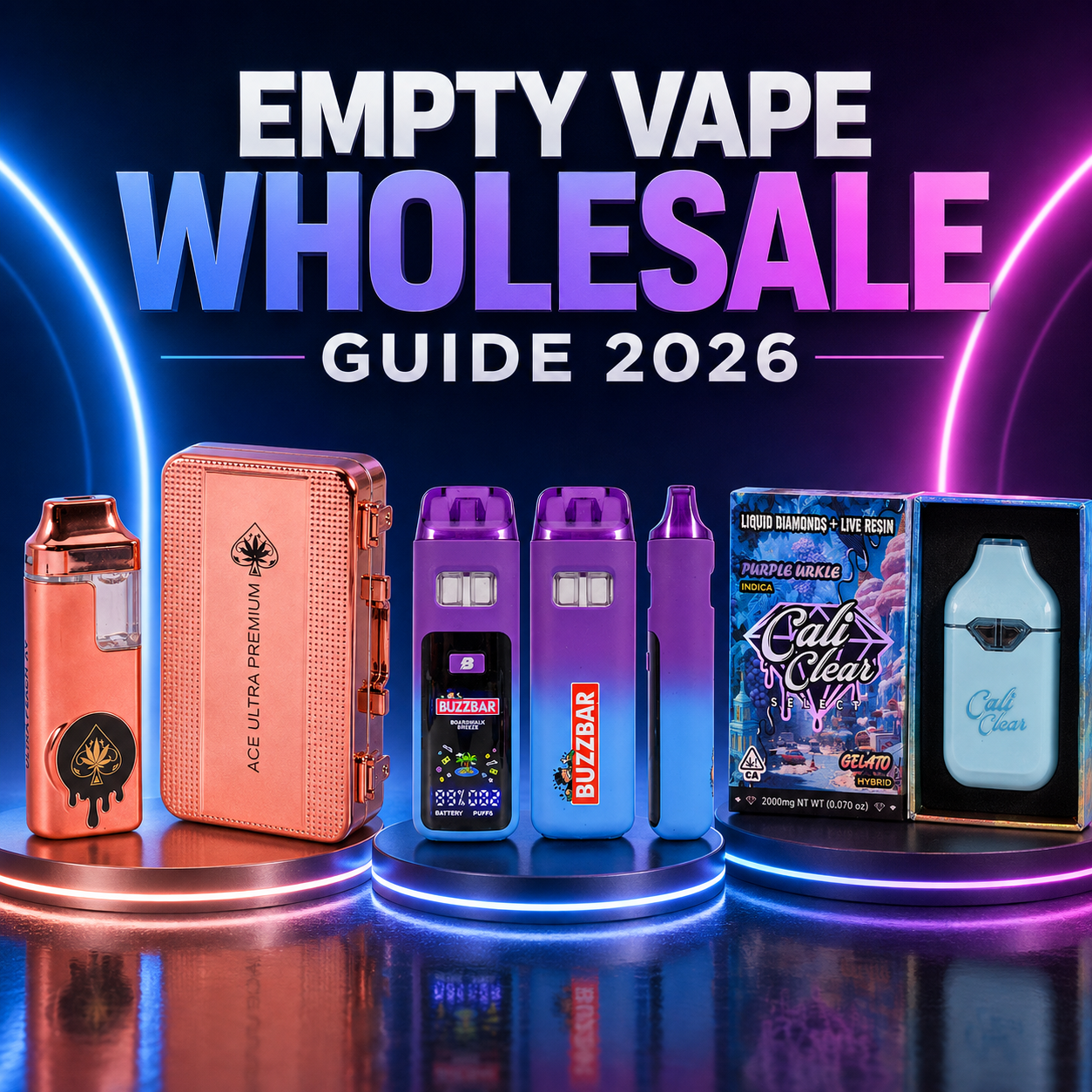
This 2026 wholesale guide explains the key factors buyers should evaluate when sourcing empty vape hardware, from initial specifications and supplier selection to sample testing, OEM, QC, logistics and final order approval.
Empty vape hardware generally refers to vaping devices or components supplied without pre-filled vaping liquid.
Depending on the design, the category may include:
For wholesale buyers, empty hardware offers more flexibility than purchasing a completely finished pre-filled product.
A brand may want to control its own filling process, formulation, packaging or product positioning. A distributor may want a particular capacity or hardware configuration for its local market. An OEM customer may need custom colors, logos, packaging or structural changes.
However, that flexibility also means the buyer has more technical decisions to make.
A device should not be selected only because its appearance matches a current market trend. The hardware must also work with the buyer’s filling process, intended formulation, target market and quality requirements.
One of the most common sourcing mistakes happens before the supplier even sends a quotation.
The buyer asks:
“What is your best price for empty vape hardware?”
But there is not enough information to produce a meaningful comparison.
Two devices that look similar may differ significantly in battery specification, chamber design, electronics, materials, packaging and customization requirements.
Before requesting a quotation, prepare a basic product specification.
A useful RFQ may include:
| Requirement | Information to Confirm |
|---|---|
| Capacity | 1g, 2g, 3g, 3.5g or other |
| Chamber | Single or dual |
| Battery | Required specification |
| Charging | USB-C or other |
| Activation | Draw activated or button activated |
| Heating structure | Ceramic or other design |
| Screen | Required or not required |
| Oil window | Required or not required |
| Branding | Stock, logo or full OEM |
| Packaging | Standard or custom |
| Order quantity | Expected production quantity |
| Destination | Country or warehouse destination |
| Delivery target | Required shipping timeline |
A better RFQ gives the supplier enough information to quote the actual project rather than a theoretical base price.
It also makes it easier for the buyer to compare multiple suppliers on the same specification.
Capacity is one of the first specifications buyers notice, but larger does not automatically mean better.
The correct capacity depends on the complete product system.
Smaller-capacity hardware may offer:
It can be useful when a buyer prioritizes compact size or wants to test a new hardware platform before committing to a larger-format product.
Two-gram hardware has become a common format in many product catalogs because it provides more capacity without necessarily requiring the size of larger devices.
Buyers should still evaluate:
As capacity increases, buyers should pay more attention to the relationship between the chamber, battery and heating system.
A larger reservoir is not useful if the rest of the device is poorly matched to the intended operating cycle.
Instead of asking:
“Which capacity is best?”
ask:
“Which capacity works best with our formulation, target product, battery design and market?”
That leads to a much more useful sourcing decision.
Another increasingly common decision is whether to use a single-chamber or dual-chamber design.
A single-chamber device generally has a simpler internal structure.
Potential advantages include:
For many projects, simplicity can be an advantage because every additional component creates another potential tolerance or assembly point.
Dual-chamber devices can provide greater product differentiation.
Depending on the design, they may support separate reservoirs or different operating modes.
However, the buyer should also consider the added complexity.
| Factor | Single Chamber | Dual Chamber |
|---|---|---|
| Internal structure | Simpler | More complex |
| Filling process | Usually simpler | More steps may be required |
| Sealing points | Fewer | More |
| Product differentiation | Standard | Higher |
| QC complexity | Lower | Higher |
| Electronics | Often simpler | May be more complex |
The right choice depends on the application.
A visually impressive dual-chamber device is not automatically a better wholesale purchase if it creates unnecessary filling, QC or cost challenges for the buyer.
For rechargeable hardware, battery and charging performance should be treated as core product specifications rather than secondary features.
Buyers should confirm items such as:
A supplier’s specification sheet is a starting point, not the end of the evaluation.
During sample testing, buyers should verify whether the actual device behaves consistently.
For example:
For hardware containing lithium cells or batteries, transportation requirements are also relevant.
The current United Nations Manual of Tests and Criteria, Revision 8 with Amendment 1 contains the Section 38.3 framework used for lithium-cell and battery testing in dangerous-goods transport. Battery documentation and transportation compliance should therefore be treated separately from normal factory functional QC.
In other words:
A device passing a factory charging test does not automatically prove that all battery transport requirements have been satisfied.
Ask for the appropriate battery documentation before arranging international shipping.
Heating technology is another area where buyers should avoid relying entirely on marketing terms.
A product may be described as using a ceramic heating element, for example, but buyers still need to evaluate how the complete device performs with the intended formulation.
Important variables can include:
The same hardware does not necessarily perform identically with every formulation.
That is why production approval should ideally be based on testing the actual hardware with the buyer’s intended filling process and formulation where legally appropriate.
Avoid assuming that:
“It worked with another customer’s material, so it will automatically work with ours.”
Compatibility testing can identify problems before those problems are multiplied across thousands of units.
Supplier selection should involve more than comparing prices on a spreadsheet.
A good supplier should be able to explain the product, manufacturing process, QC procedures, customization options and production limitations clearly.
Start by understanding what type of company you are dealing with.
A manufacturer may offer advantages such as:
A trading company may offer different advantages:
Neither model is automatically better.
The question is whether the supplier’s capabilities match the buyer’s project.
A professional buyer should consider asking:
The quality of a supplier’s answers is often as important as the answers themselves.
Vague claims such as “best quality” or “no problems” provide very little useful information.
Specific explanations of materials, testing, sample approval and corrective processes are much more valuable.
Sample testing is one of the most important stages of wholesale purchasing.
A product photo cannot tell you whether airflow is consistent, the charging port is reliable or the mouthpiece seals correctly.
Google’s own guidance for high-quality product evaluation recommends first-hand evidence, visuals, quantitative measurements, benefits and drawbacks, and explanation of the factors that actually matter to a purchasing decision.
Wholesale buyers should apply the same principle.
Do not evaluate only appearance.
Check:
Where dimensions are critical, measure them.
Possible measurements include:
Evaluate:
If the hardware will be used with a specific formulation, test the intended formulation rather than assuming compatibility.
Document:
Where applicable, observe samples in defined positions such as:
The useful information is not simply:
“Leak test passed.”
A better record says:
This type of documentation creates a much stronger basis for mass-production approval.
MOQ means Minimum Order Quantity, but there is no universal MOQ for empty vape hardware.
It can vary according to:
The MOQ for a standard stock model may therefore be different from the MOQ for an OEM project.
The same is true for pricing.
A supplier may offer one MOQ for:
standard device + standard packaging
and a different MOQ for:
custom device color + logo + customized retail box.
When requesting quotations, ask suppliers to separate these variables.
That makes it easier to understand which customization requirement is increasing the minimum quantity or cost.
Suppose Supplier A quotes a lower unit price than Supplier B.
That does not automatically mean Supplier A is cheaper.
The real purchasing cost may include:
A basic purchasing model is:
Landed Cost = Product Cost + Packaging + Freight + Duties/Taxes + Handling + Other Import Costs
Then divide the total by the number of usable units.
This becomes especially important when comparing:
The cheapest factory quote can become expensive if it creates higher logistics, defect or inventory costs.
Quality control should be discussed before production begins.
Do not wait until the goods are packed to ask:
“How do you inspect the order?”
A practical QC process can include:
For finished-lot inspection, one important 2026 development is the publication of ISO 2859-1:2026.
The third edition was published in January 2026 and replaces the earlier 1999 edition. It provides AQL-indexed acceptance-sampling schemes for lot-by-lot inspection by attributes.
AQL means Acceptance Quality Limit.
However, buyers should not treat the existence of an ISO standard as proof that every supplier follows it.
Ask:
If a supplier claims to use an ISO-based AQL inspection process, ask for the actual inspection plan used for your order.
Packaging mistakes can delay an otherwise successful production run.
Before mass production, confirm:
For custom projects, an approved golden sample or final packaging proof can prevent misunderstandings later.
Do not assume that approving the device automatically means the packaging is approved.
Treat hardware and packaging as two separate approval items.
Wholesale buyers increasingly have another decision to make:
Should we buy local stock or order directly from the factory?
Both models can make sense.
| Factor | Local Warehouse | Factory Direct |
|---|---|---|
| Delivery time | Usually faster | Usually longer |
| Product selection | Limited to stock | Wider production options |
| Customization | Usually limited | More flexible |
| Small orders | Often convenient | Depends on MOQ |
| Large-volume pricing | May be higher | Often more competitive |
| OEM projects | Limited | Better suited |
Professional buyers may use both.
For example, local inventory can support immediate demand while factory-direct production supports the next larger replenishment cycle.
Lead time should be separated into two parts.
Production time can depend on:
Ask the supplier what event starts the lead-time clock.
Is it:
This avoids misunderstandings.
After production, shipping depends on:
Products containing lithium batteries can also be subject to dangerous-goods requirements, so the fastest quoted transport option may not necessarily be available for every configuration.
Build additional time into the purchasing plan for documentation and customs rather than assuming production completion equals delivery.
This is one of the most important changes in wholesale sourcing in 2026.
Regulations vary substantially by country, device type, intended contents and business model.
Empty hardware should not automatically be treated as legally unrestricted simply because it contains no liquid at the time of shipment.
Current ATF guidance states that the PACT Act definition of Electronic Nicotine Delivery Systems includes electronic devices that deliver nicotine, flavor or another substance and includes components, parts and accessories even when sold separately. ATF’s ENDS FAQ was last updated in January 2026.
USPS similarly defines ENDS broadly to include components, liquids, parts and accessories regardless of whether they are sold separately or used with nicotine, and covered products are generally nonmailable except where specific exceptions apply.
For a U.S. buyer, this means shipping should be evaluated before placing the order—not after the cartons are ready.
The UK prohibition on single-use vapes has been in force since 1 June 2025.
The government guidance states that it applies to online and physical sales, to products whether or not they contain nicotine, and to manufacturers, wholesalers and importers as well as retailers. A reusable vape must meet the applicable rechargeable and refillable criteria described by the government.
Another major change takes effect on 1 October 2026, when the UK’s Vaping Products Duty begins.
The duty itself applies to vaping liquid within its statutory scope, while the associated duty-stamp regime affects liable vaping products entering the UK supply chain. Current HMRC guidance states that liable products released onto the UK market from 1 October 2026 must carry the required duty stamp, subject to transitional arrangements.
An empty hardware buyer should therefore distinguish between:
Do not rely on a generic statement such as:
“Empty means unrestricted.”
Verify the requirements for the exact product and destination.
This section is general information and does not constitute legal, customs or regulatory advice.
A structured purchasing process helps prevent expensive changes after production has started.
A typical workflow can look like this:
Confirm:
Include:
Evaluate the actual physical hardware.
Test:
Freeze the specification before mass production.
Use this as the reference for the production order.
Check logo, colors, text, barcode and carton information.
Confirm lead time and production schedule.
Identify problems before the entire lot is completed.
Apply the agreed inspection criteria.
Verify:
Use a transport method appropriate for the product and destination.
Saving a few cents per unit can become expensive if the product creates a higher defect rate, poor compatibility or additional inspection costs.
Compare total value and landed cost.
A catalog image and specification sheet cannot replace physical evaluation.
Always test the model you plan to purchase.
If there is no written specification or golden sample, both buyer and supplier may have different interpretations of what is acceptable.
Hardware performance can depend on the material being filled into it.
Test the intended combination whenever appropriate.
Inspection criteria should be agreed before production begins.
Changing color, packaging, dimensions or components after production starts can increase cost and delay delivery.
Battery products and vape-related hardware can face carrier and destination-market restrictions.
Check shipping options before placing the purchase order.
For a new product, a sensible sourcing path may be:
sample testing → pilot order → larger repeat order
rather than moving immediately from one sample to maximum production volume.
Before approving your next order, review this checklist.
☐ Capacity confirmed
☐ Chamber configuration confirmed
☐ Battery specification confirmed
☐ Heating system confirmed
☐ Charging method confirmed
☐ Device dimensions confirmed
☐ Color and surface finish approved
☐ Appearance inspected
☐ Dimensions measured
☐ Airflow tested
☐ Draw activation tested
☐ Charging tested
☐ Formulation compatibility evaluated
☐ Leakage testing completed where applicable
☐ Aging/storage observation completed where required
☐ Manufacturer/company information verified
☐ MOQ confirmed
☐ Production lead time confirmed
☐ QC process reviewed
☐ Battery documentation reviewed where applicable
☐ Corrective process discussed
☐ Logo approved
☐ Artwork approved
☐ Packaging approved
☐ Barcode verified
☐ Carton marks confirmed
☐ Golden sample approved
☐ Shipping method confirmed
☐ Battery transport requirements checked
☐ Destination-country rules reviewed
☐ Import requirements reviewed
☐ Carrier restrictions confirmed
There is no universal MOQ.
MOQ depends on the product, stock status, color, logo requirements, packaging and whether new tooling or custom components are required.
A standard model will usually have different order requirements from a fully customized OEM or ODM project.
Yes.
Samples allow buyers to evaluate appearance, dimensions, airflow, charging, battery behavior, filling compatibility and other product-specific requirements before mass production.
The more customized or technically complex the product is, the more important sample approval becomes.
Do not compare only unit price.
Compare:
At minimum, consider testing:
The exact test plan depends on the device.
OEM usually starts with an existing product platform and customizes branding, color or packaging.
ODM can involve deeper changes to structure, tooling, electronics or other product features.
Always ask the supplier exactly which elements can be customized.
Yes.
Being empty does not remove potential hardware defects.
Buyers should still evaluate batteries, electronics, chambers, seals, dimensions, airflow, charging, appearance and packaging.
Hardware-related causes can include sealing problems, damaged components, dimensional variation and chamber construction.
However, leakage can also be influenced by filling method, formulation viscosity, temperature, filling volume, capping and storage conditions.
For that reason, leakage should be evaluated as a complete system rather than only a hardware specification.
It depends on the project.
Local stock is useful when speed and lower initial quantity are important.
Factory-direct purchasing can be more suitable for larger orders, OEM requirements and longer-term supply programs.
Possibly, but the answer depends on the hardware, battery, carrier, origin and destination.
Vape-related devices can be subject to product-specific or carrier restrictions even when shipped empty. Lithium batteries introduce additional transport requirements.
Always confirm the exact shipping route before placing a bulk order.
Successful empty vape hardware sourcing is not simply a search for the lowest unit price.
A professional wholesale purchasing process connects every stage:
product specification → supplier evaluation → sample testing → OEM approval → quality control → compliance → logistics → final delivery
When these decisions are made before production, buyers have a much better chance of controlling quality, cost and lead time.
When they are left until after production, even a low-priced order can become expensive.
The most useful supplier is therefore not necessarily the company with the longest catalog or the lowest quotation.
It is the supplier that can help you clearly define what will be produced, how it will be evaluated and what must happen before the order is approved for shipment.
If you are preparing a wholesale or OEM empty vape hardware project, start with a clear specification, test the physical samples carefully and define your QC and shipping requirements before mass production begins.
That process is more valuable than any “best price” quotation.
Buying a few empty vape hardware samples is relatively simple. Buying thousands of units is a different process entirely.
At wholesale scale, the lowest unit price is rarely the only factor that matters. Product design, battery consistency, chamber construction, filling compatibility, leakage risk, minimum order quantity, OEM requirements, production lead time, quality control, shipping and destination-market regulations can all affect the real cost of an order.
For professional buyers, the goal is therefore not simply to find a product that looks good in a catalog.
The goal is to build a purchasing process that reduces uncertainty before mass production begins.
This 2026 wholesale guide explains the key factors buyers should evaluate when sourcing empty vape hardware, from initial specifications and supplier selection to sample testing, OEM, QC, logistics and final order approval.
Empty vape hardware generally refers to vaping devices or components supplied without pre-filled vaping liquid.
Depending on the design, the category may include:
For wholesale buyers, empty hardware offers more flexibility than purchasing a completely finished pre-filled product.
A brand may want to control its own filling process, formulation, packaging or product positioning. A distributor may want a particular capacity or hardware configuration for its local market. An OEM customer may need custom colors, logos, packaging or structural changes.
However, that flexibility also means the buyer has more technical decisions to make.
A device should not be selected only because its appearance matches a current market trend. The hardware must also work with the buyer’s filling process, intended formulation, target market and quality requirements.
One of the most common sourcing mistakes happens before the supplier even sends a quotation.
The buyer asks:
“What is your best price for empty vape hardware?”
But there is not enough information to produce a meaningful comparison.
Two devices that look similar may differ significantly in battery specification, chamber design, electronics, materials, packaging and customization requirements.
Before requesting a quotation, prepare a basic product specification.
A useful RFQ may include:
| Requirement | Information to Confirm |
|---|---|
| Capacity | 1g, 2g, 3g, 3.5g or other |
| Chamber | Single or dual |
| Battery | Required specification |
| Charging | USB-C or other |
| Activation | Draw activated or button activated |
| Heating structure | Ceramic or other design |
| Screen | Required or not required |
| Oil window | Required or not required |
| Branding | Stock, logo or full OEM |
| Packaging | Standard or custom |
| Order quantity | Expected production quantity |
| Destination | Country or warehouse destination |
| Delivery target | Required shipping timeline |
A better RFQ gives the supplier enough information to quote the actual project rather than a theoretical base price.
It also makes it easier for the buyer to compare multiple suppliers on the same specification.
Capacity is one of the first specifications buyers notice, but larger does not automatically mean better.
The correct capacity depends on the complete product system.
Smaller-capacity hardware may offer:
It can be useful when a buyer prioritizes compact size or wants to test a new hardware platform before committing to a larger-format product.
Two-gram hardware has become a common format in many product catalogs because it provides more capacity without necessarily requiring the size of larger devices.
Buyers should still evaluate:
As capacity increases, buyers should pay more attention to the relationship between the chamber, battery and heating system.
A larger reservoir is not useful if the rest of the device is poorly matched to the intended operating cycle.
Instead of asking:
“Which capacity is best?”
ask:
“Which capacity works best with our formulation, target product, battery design and market?”
That leads to a much more useful sourcing decision.
Another increasingly common decision is whether to use a single-chamber or dual-chamber design.
A single-chamber device generally has a simpler internal structure.
Potential advantages include:
For many projects, simplicity can be an advantage because every additional component creates another potential tolerance or assembly point.
Dual-chamber devices can provide greater product differentiation.
Depending on the design, they may support separate reservoirs or different operating modes.
However, the buyer should also consider the added complexity.
| Factor | Single Chamber | Dual Chamber |
|---|---|---|
| Internal structure | Simpler | More complex |
| Filling process | Usually simpler | More steps may be required |
| Sealing points | Fewer | More |
| Product differentiation | Standard | Higher |
| QC complexity | Lower | Higher |
| Electronics | Often simpler | May be more complex |
The right choice depends on the application.
A visually impressive dual-chamber device is not automatically a better wholesale purchase if it creates unnecessary filling, QC or cost challenges for the buyer.
For rechargeable hardware, battery and charging performance should be treated as core product specifications rather than secondary features.
Buyers should confirm items such as:
A supplier’s specification sheet is a starting point, not the end of the evaluation.
During sample testing, buyers should verify whether the actual device behaves consistently.
For example:
For hardware containing lithium cells or batteries, transportation requirements are also relevant.
The current United Nations Manual of Tests and Criteria, Revision 8 with Amendment 1 contains the Section 38.3 framework used for lithium-cell and battery testing in dangerous-goods transport. Battery documentation and transportation compliance should therefore be treated separately from normal factory functional QC.
In other words:
A device passing a factory charging test does not automatically prove that all battery transport requirements have been satisfied.
Ask for the appropriate battery documentation before arranging international shipping.
Heating technology is another area where buyers should avoid relying entirely on marketing terms.
A product may be described as using a ceramic heating element, for example, but buyers still need to evaluate how the complete device performs with the intended formulation.
Important variables can include:
The same hardware does not necessarily perform identically with every formulation.
That is why production approval should ideally be based on testing the actual hardware with the buyer’s intended filling process and formulation where legally appropriate.
Avoid assuming that:
“It worked with another customer’s material, so it will automatically work with ours.”
Compatibility testing can identify problems before those problems are multiplied across thousands of units.
Supplier selection should involve more than comparing prices on a spreadsheet.
A good supplier should be able to explain the product, manufacturing process, QC procedures, customization options and production limitations clearly.
Start by understanding what type of company you are dealing with.
A manufacturer may offer advantages such as:
A trading company may offer different advantages:
Neither model is automatically better.
The question is whether the supplier’s capabilities match the buyer’s project.
A professional buyer should consider asking:
The quality of a supplier’s answers is often as important as the answers themselves.
Vague claims such as “best quality” or “no problems” provide very little useful information.
Specific explanations of materials, testing, sample approval and corrective processes are much more valuable.
Sample testing is one of the most important stages of wholesale purchasing.
A product photo cannot tell you whether airflow is consistent, the charging port is reliable or the mouthpiece seals correctly.
Google’s own guidance for high-quality product evaluation recommends first-hand evidence, visuals, quantitative measurements, benefits and drawbacks, and explanation of the factors that actually matter to a purchasing decision.
Wholesale buyers should apply the same principle.
Do not evaluate only appearance.
Check:
Where dimensions are critical, measure them.
Possible measurements include:
Evaluate:
If the hardware will be used with a specific formulation, test the intended formulation rather than assuming compatibility.
Document:
Where applicable, observe samples in defined positions such as:
The useful information is not simply:
“Leak test passed.”
A better record says:
This type of documentation creates a much stronger basis for mass-production approval.
MOQ means Minimum Order Quantity, but there is no universal MOQ for empty vape hardware.
It can vary according to:
The MOQ for a standard stock model may therefore be different from the MOQ for an OEM project.
The same is true for pricing.
A supplier may offer one MOQ for:
standard device + standard packaging
and a different MOQ for:
custom device color + logo + customized retail box.
When requesting quotations, ask suppliers to separate these variables.
That makes it easier to understand which customization requirement is increasing the minimum quantity or cost.
The terms OEM and ODM are often used loosely, so buyers should define exactly what they expect.
For many buyers, OEM means starting with an existing hardware platform and customizing elements such as:
This is usually more straightforward than developing a completely new device.
A deeper ODM project may involve changes to:
That can require more development work, longer lead times and higher minimum quantities.
| Factor | OEM | ODM |
|---|---|---|
| Existing platform | Usually | Not always |
| Custom logo | Yes | Yes |
| Custom packaging | Yes | Yes |
| Structural changes | Limited | More extensive |
| New tooling | Often unnecessary | May be required |
| Development time | 30 days | Usually longer |
| Engineering involvement | Moderate | Higher |
The important question is not whether a supplier says “OEM available.”
Ask exactly which parts can be changed.
Suppose Supplier A quotes a lower unit price than Supplier B.
That does not automatically mean Supplier A is cheaper.
The real purchasing cost may include:
A basic purchasing model is:
Landed Cost = Product Cost + Packaging + Freight + Duties/Taxes + Handling + Other Import Costs
Then divide the total by the number of usable units.
This becomes especially important when comparing:
The cheapest factory quote can become expensive if it creates higher logistics, defect or inventory costs.
Quality control should be discussed before production begins.
Do not wait until the goods are packed to ask:
“How do you inspect the order?”
A practical QC process can include:
For finished-lot inspection, one important 2026 development is the publication of ISO 2859-1:2026.
The third edition was published in January 2026 and replaces the earlier 1999 edition. It provides AQL-indexed acceptance-sampling schemes for lot-by-lot inspection by attributes.
AQL means Acceptance Quality Limit.
However, buyers should not treat the existence of an ISO standard as proof that every supplier follows it.
Ask:
If a supplier claims to use an ISO-based AQL inspection process, ask for the actual inspection plan used for your order.
Packaging mistakes can delay an otherwise successful production run.
Before mass production, confirm:
For custom projects, an approved golden sample or final packaging proof can prevent misunderstandings later.
Do not assume that approving the device automatically means the packaging is approved.
Treat hardware and packaging as two separate approval items.
Wholesale buyers increasingly have another decision to make:
Should we buy local stock or order directly from the factory?
Both models can make sense.
| Factor | Local Warehouse | Factory Direct |
|---|---|---|
| Delivery time | 5-7 days | 10-1 5days |
| Product selection | Limited to stock | Wider production options |
| Customization | Usually limited | More flexible |
| Small orders | Often convenient | Depends on MOQ |
| Large-volume pricing | May be higher | Often more competitive |
| OEM projects | Limited | Better suited |
Professional buyers may use both.
For example, local inventory can support immediate demand while factory-direct production supports the next larger replenishment cycle.
Lead time should be separated into two parts.
Production time can depend on:
Ask the supplier what event starts the lead-time clock.
Is it:
This avoids misunderstandings.
After production, shipping depends on:
Products containing lithium batteries can also be subject to dangerous-goods requirements, so the fastest quoted transport option may not necessarily be available for every configuration.
Build additional time into the purchasing plan for documentation and customs rather than assuming production completion equals delivery.
This is one of the most important changes in wholesale sourcing in 2026.
Regulations vary substantially by country, device type, intended contents and business model.
Empty hardware should not automatically be treated as legally unrestricted simply because it contains no liquid at the time of shipment.
Current ATF guidance states that the PACT Act definition of Electronic Nicotine Delivery Systems includes electronic devices that deliver nicotine, flavor or another substance and includes components, parts and accessories even when sold separately. ATF’s ENDS FAQ was last updated in January 2026.
USPS similarly defines ENDS broadly to include components, liquids, parts and accessories regardless of whether they are sold separately or used with nicotine, and covered products are generally nonmailable except where specific exceptions apply.
For a U.S. buyer, this means shipping should be evaluated before placing the order—not after the cartons are ready.
The UK prohibition on single-use vapes has been in force since 1 June 2025.
The government guidance states that it applies to online and physical sales, to products whether or not they contain nicotine, and to manufacturers, wholesalers and importers as well as retailers. A reusable vape must meet the applicable rechargeable and refillable criteria described by the government.
Another major change takes effect on 1 October 2026, when the UK’s Vaping Products Duty begins.
The duty itself applies to vaping liquid within its statutory scope, while the associated duty-stamp regime affects liable vaping products entering the UK supply chain. Current HMRC guidance states that liable products released onto the UK market from 1 October 2026 must carry the required duty stamp, subject to transitional arrangements.
An empty hardware buyer should therefore distinguish between:
Do not rely on a generic statement such as:
“Empty means unrestricted.”
Verify the requirements for the exact product and destination.
This section is general information and does not constitute legal, customs or regulatory advice.
A structured purchasing process helps prevent expensive changes after production has started.
A typical workflow can look like this:
Confirm:
Include:
Evaluate the actual physical hardware.
Test:
Freeze the specification before mass production.
Use this as the reference for the production order.
Check logo, colors, text, barcode and carton information.
Confirm lead time and production schedule.
Identify problems before the entire lot is completed.
Apply the agreed inspection criteria.
Verify:
Use a transport method appropriate for the product and destination.
Saving a few cents per unit can become expensive if the product creates a higher defect rate, poor compatibility or additional inspection costs.
Compare total value and landed cost.
A catalog image and specification sheet cannot replace physical evaluation.
Always test the model you plan to purchase.
If there is no written specification or golden sample, both buyer and supplier may have different interpretations of what is acceptable.
Hardware performance can depend on the material being filled into it.
Test the intended combination whenever appropriate.
Inspection criteria should be agreed before production begins.
Changing color, packaging, dimensions or components after production starts can increase cost and delay delivery.
Battery products and vape-related hardware can face carrier and destination-market restrictions.
Check shipping options before placing the purchase order.
For a new product, a sensible sourcing path may be:
sample testing → pilot order → larger repeat order
rather than moving immediately from one sample to maximum production volume.
Before approving your next order, review this checklist.
☐ Capacity confirmed
☐ Chamber configuration confirmed
☐ Battery specification confirmed
☐ Heating system confirmed
☐ Charging method confirmed
☐ Device dimensions confirmed
☐ Color and surface finish approved
☐ Appearance inspected
☐ Dimensions measured
☐ Airflow tested
☐ Draw activation tested
☐ Charging tested
☐ Formulation compatibility evaluated
☐ Leakage testing completed where applicable
☐ Aging/storage observation completed where required
☐ Manufacturer/company information verified
☐ MOQ confirmed
☐ Production lead time confirmed
☐ QC process reviewed
☐ Battery documentation reviewed where applicable
☐ Corrective process discussed
☐ Logo approved
☐ Artwork approved
☐ Packaging approved
☐ Barcode verified
☐ Carton marks confirmed
☐ Golden sample approved
☐ Shipping method confirmed
☐ Battery transport requirements checked
☐ Destination-country rules reviewed
☐ Import requirements reviewed
☐ Carrier restrictions confirmed
There is no universal MOQ.
MOQ depends on the product, stock status, color, logo requirements, packaging and whether new tooling or custom components are required.
A standard model will usually have different order requirements from a fully customized OEM or ODM project.
Yes.
Samples allow buyers to evaluate appearance, dimensions, airflow, charging, battery behavior, filling compatibility and other product-specific requirements before mass production.
The more customized or technically complex the product is, the more important sample approval becomes.
Do not compare only unit price.
Compare:
At minimum, consider testing:
The exact test plan depends on the device.
OEM usually starts with an existing product platform and customizes branding, color or packaging.
ODM can involve deeper changes to structure, tooling, electronics or other product features.
Always ask the supplier exactly which elements can be customized.
Yes.
Being empty does not remove potential hardware defects.
Buyers should still evaluate batteries, electronics, chambers, seals, dimensions, airflow, charging, appearance and packaging.
Hardware-related causes can include sealing problems, damaged components, dimensional variation and chamber construction.
However, leakage can also be influenced by filling method, formulation viscosity, temperature, filling volume, capping and storage conditions.
For that reason, leakage should be evaluated as a complete system rather than only a hardware specification.
It depends on the project.
Local stock is useful when speed and lower initial quantity are important.
Factory-direct purchasing can be more suitable for larger orders, OEM requirements and longer-term supply programs.
Possibly, but the answer depends on the hardware, battery, carrier, origin and destination.
Vape-related devices can be subject to product-specific or carrier restrictions even when shipped empty. Lithium batteries introduce additional transport requirements.
Always confirm the exact shipping route before placing a bulk order.
Successful empty vape hardware sourcing is not simply a search for the lowest unit price.
A professional wholesale purchasing process connects every stage:
product specification → supplier evaluation → sample testing → OEM approval → quality control → compliance → logistics → final delivery
When these decisions are made before production, buyers have a much better chance of controlling quality, cost and lead time.
When they are left until after production, even a low-priced order can become expensive.
The most useful supplier is therefore not necessarily the company with the longest catalog or the lowest quotation.
It is the supplier that can help you clearly define what will be produced, how it will be evaluated and what must happen before the order is approved for shipment.
If you are preparing a wholesale or OEM empty vape hardware project, start with a clear specification, test the physical samples carefully and define your QC and shipping requirements before mass production begins.
That process is more valuable than any “best price” quotation.
Get A Free Quote
Related blogs
For wholesale buyers, this gives the product two layers of differentiation. On the technical side, the device uses a nominal
Big Chief Duo V2 2G Disposable Vape: Dual Chamber Design, 20 Flavors & USA Wholesale Guide
The Big Chief Duo V2 2G Disposable Vape is built around a 1ml + 1ml dual-chamber configuration, giving wholesale buyers

Push 2G Disposable Vape With Screen: Design, Features & USA Wholesale Guide
The Push 2G Disposable Vape With Screen combines a compact 2ml hardware format with an integrated display, multiple product options,
You must be 18 years of age or older to view page. Please verify your age to enter.
Your access is restricted because of your age.

Hello, please contact us if you have any questions!
Whatsapp : +1-713-363-1015
Telegram : @Amy99812
Email : chengstella120@gmail.com
iMessage: +1-713-363-1015