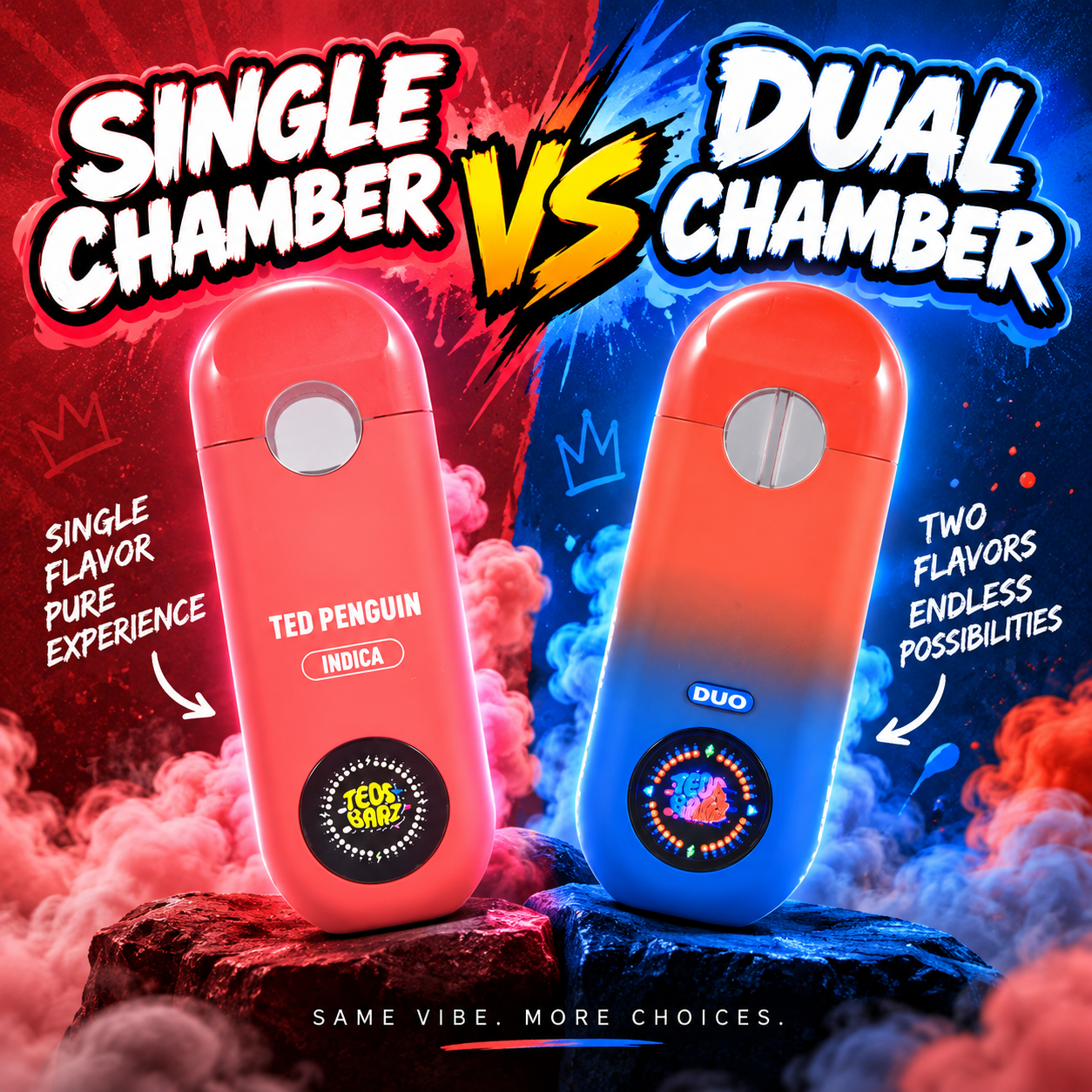
Single-chamber and dual-chamber vape hardware may look similar from the outside, but the internal design can be very different.
For wholesale buyers, brand owners and private-label projects, that difference matters.
The chamber structure can affect:
filling procedures;
sealing requirements;
airflow;
heating configuration;
battery demand;
electronics;
quality control;
OEM complexity;
production cost.
A dual-chamber device may offer more product differentiation, but it can also introduce additional components and additional failure points that must be controlled during production.
A single-chamber device may be easier to fill and inspect, but it may provide fewer options for brands that want multiple formulations, switching functions or more advanced product positioning.
So the right question is not:
“Is dual chamber better than single chamber?”
A better question is:
“Which chamber design can our filling process, formulation, QC system and target market support consistently?”
This guide compares single-chamber and dual-chamber vape hardware from a B2B sourcing and manufacturing perspective.
What Is Single-Chamber Vape Hardware?
Single-chamber vape hardware generally uses one primary liquid reservoir.
Depending on the design, it may include:
one filling area;
one main liquid path;
one heating system;
one airflow system;
one primary sealing structure.
Because the internal layout is relatively simple, single-chamber hardware often requires fewer components and fewer assembly steps.
That can make it easier to:
fill;
inspect;
troubleshoot;
scale into mass production.
However, a simpler design does not automatically mean the product cannot leak or fail.
Actual performance still depends on factors such as:
dimensional tolerance;
sealing quality;
formulation compatibility;
filling volume;
capping procedure;
battery performance.
Single-chamber hardware should still be tested under the buyer’s intended production conditions.
What Is Dual-Chamber Vape Hardware?
Dual-chamber vape hardware typically contains two separate liquid reservoirs or two independently managed liquid paths.
Depending on the specific architecture, a dual-chamber device may support:
two formulations;
two flavors;
two heating systems;
separate airflow paths;
shared airflow;
chamber switching;
combination or blend modes;
independent activation.
However, the term “dual chamber” does not describe one universal design.
Different suppliers may use very different internal architectures.
For example, one device may have two completely independent reservoirs and heating elements.
Another may use two reservoirs but a shared airflow system.
Another may allow the user to switch between chambers electronically.
This is why buyers should ask for the actual internal structure and operating logic rather than relying only on the phrase “dual chamber.”
Single Chamber vs Dual Chamber: Quick Comparison
Factor
Single Chamber
Dual Chamber
Liquid reservoirs
1
2
Internal structure
Simpler
More complex
Filling process
Usually simpler
More steps
Sealing points
Fewer
More
Heating systems
Usually one
May be one or two
Airflow design
Usually simpler
May be shared or separate
Electronics
Usually simpler
Often more complex
Product differentiation
Moderate
Higher
QC complexity
Lower
Higher
OEM potential
Standard
Higher
Production cost
Usually lower
Usually higher
Potential failure points
Fewer
More possible interfaces
The table shows the general pattern, but actual performance depends on the exact device.
1. Structural Complexity
The first major difference is internal complexity.
Single-Chamber Structure
A single-chamber design typically contains fewer interfaces between the liquid reservoir, heating system, airflow path and mouthpiece.
That can reduce the number of components that must be aligned and sealed correctly.
From a manufacturing perspective, this can make the product easier to:
assemble;
measure;
inspect;
troubleshoot.
It can also simplify the production line.
Dual-Chamber Structure
A dual-chamber system adds another reservoir and often additional:
seals;
liquid paths;
heating components;
airflow channels;
electronic functions.
Some designs also include:
switching buttons;
displays;
mode indicators;
control-board logic.
More components do not automatically mean worse quality.
They simply mean more variables must remain within specification.
For a B2B buyer, the key issue is whether the supplier can control those additional variables consistently during mass production.
2. Filling Process Differences
Filling is one of the biggest operational differences between single- and dual-chamber hardware.
Filling Single-Chamber Hardware
A typical process may involve:
one fill point;
one filling volume;
one capping process.
That can make production easier for companies using manual or semi-automatic filling systems.
The filling SOP is also easier to standardize.
Filling Dual-Chamber Hardware
Dual-chamber devices can require:
separate filling points;
two filling volumes;
separate formulations;
specific filling sequence;
tighter process control.
For example, the operator may need to ensure that:
Chamber A receives the correct formulation;
Chamber B receives the correct formulation;
both chambers receive the correct amount;
no liquid enters the wrong chamber;
no contamination occurs between the two filling paths.
If the two formulations have different viscosities, the filling settings may also need to be adjusted.
This makes dual-chamber production more demanding.
Questions Buyers Should Ask
Before ordering dual-chamber hardware, ask:
Does each chamber have a separate filling port?
What fill volume is recommended for each chamber?
Can the same filling equipment be used for both chambers?
Is there a recommended filling sequence?
Is there a maximum recommended fill-to-cap time?
Can the supplier provide a filling SOP?
These questions can prevent production problems later.
3. Sealing and Leakage Risk
Sealing is one of the most important technical differences between the two designs.
A single-chamber device usually has fewer interfaces that must prevent liquid migration.
A dual-chamber device may introduce:
additional chamber walls;
chamber separators;
more silicone components;
additional joints;
more internal interfaces.
That does not mean dual-chamber hardware automatically leaks more.
A properly designed and manufactured dual-chamber device can perform consistently.
The correct conclusion is:
More sealing interfaces create more points that must be controlled during design, assembly and QC.
What Buyers Should Check
For both designs, inspect:
chamber fit;
silicone condition;
mouthpiece fit;
visible gaps;
chamber joints;
dimensional consistency.
For dual-chamber products, also check:
the separator between the chambers;
whether liquid can migrate from one chamber to the other;
whether both chambers seal independently;
whether the shared airflow path can become flooded.
Leakage should be evaluated with actual filled samples under defined conditions rather than predicted only from the number of chambers.
4. Airflow Design
Airflow becomes more complicated when two liquid systems are involved.
Single-Chamber Airflow
A single-chamber device often has one main airflow path.
That can make it easier to control:
draw resistance;
pressure balance;
sensor activation;
heating response.
Dual-Chamber Airflow
Dual-chamber hardware may use:
shared airflow;
independent airflow;
selector-controlled airflow.
Each configuration creates different design questions.
For example:
Does each chamber have an independent airway?
Does switching chambers change draw resistance?
Can liquid from one chamber enter the shared airflow path?
Can pressure changes in one chamber influence the other?
Are both chambers activated equally?
For B2B buyers, airflow should be tested chamber by chamber.
Do not assume that because Chamber A performs well, Chamber B automatically behaves identically.
5. Heating System Differences
Heating architecture is another major distinction.
A single-chamber device often uses one primary heating element.
A dual-chamber device may use:
one heating element per chamber;
two independently controlled heating elements;
a shared heating structure;
different activation modes.
This can affect:
resistance;
power demand;
heating response;
formulation compatibility;
battery life.
A buyer should not evaluate a dual-chamber product only by total capacity.
The heating system matters just as much.
Questions to Ask
Does each chamber have its own heating element?
Are the heating elements identical?
Can each chamber operate independently?
Can both operate at the same time?
How is power distributed?
Is the activation logic mechanical or electronic?
These details can affect both product performance and QC requirements.
6. Battery Requirements
Dual-chamber devices often include more electronics and may require more power.
Additional features can include:
dual heating systems;
switching functions;
displays;
LEDs;
mode controls.
That can increase electrical demand.
Single Chamber
A simpler device may use:
simpler PCB logic;
fewer electronic components;
lower power demand.
Dual Chamber
A more advanced device may require:
more control functions;
higher battery capacity;
more complex power management.
Buyers should not compare products based only on the battery capacity printed in the specification sheet.
Also evaluate:
actual load;
charging behavior;
control-board design;
protection features;
expected usage cycle.
A higher mAh number is not automatically proof of a better electrical system.
7. Electronics and User Controls
Single-chamber hardware is often simpler from a user-interface perspective.
Common features may include:
draw activation;
one LED;
basic battery indicator.
Dual-chamber hardware may add:
chamber switching;
screen display;
mode buttons;
dual indicators;
blend modes;
independent activation.
These features can make the product more attractive, but they also create more potential failure modes.
Possible issues include:
switch failure;
incorrect chamber activation;
screen malfunction;
inconsistent power distribution;
control-board problems.
For a wholesale buyer, every additional feature should have a corresponding QC check.
8. Quality Control Requirements
QC is one of the most important differences between the two architectures.
Single-Chamber QC
Typical checks may include:
chamber sealing;
dimensional inspection;
airflow;
battery;
charging;
activation;
appearance.
Dual-Chamber QC
Dual-chamber hardware may require all of the above plus:
Chamber A sealing;
Chamber B sealing;
Chamber A airflow;
Chamber B airflow;
separate heating operation;
switching function;
cross-chamber contamination;
dual filling consistency.
QC Item
Single Chamber
Dual Chamber
Chamber sealing
1 system
2 systems
Filling validation
1 path
2 paths
Airflow testing
Standard
More complex
Heating test
Usually one
May require two
Switching test
Usually not needed
Often required
Cross-chamber check
Not applicable
Important
Electronics check
Simpler
More functions
The main point is simple:
Dual-chamber QC should not be treated as single-chamber QC multiplied by two.
The interaction between the two chambers also needs to be tested.
9. Production Consistency
A dual-chamber sample may perform very well during initial testing.
That does not guarantee that every production unit will behave the same.
Mass production introduces variation in:
chamber dimensions;
silicone components;
separator alignment;
electronics;
switching parts;
assembly pressure.
This is why production consistency is especially important for more complex hardware.
Ask the supplier:
How do you control consistency between Chamber A and Chamber B during production?
A good answer should involve more than visual inspection.
Depending on the design, the factory may need to control:
dimensions;
seal placement;
heating resistance;
switch function;
airflow;
electrical performance.
10. OEM and Customization
Dual-chamber hardware can offer more opportunities for product differentiation.
For example, buyers may customize:
chamber labels;
shell colors;
display;
switching logic;
mouthpiece;
packaging;
printed graphics.
A brand may also position the two chambers around separate formulations or product concepts.
However, more customization can create:
higher MOQ;
longer development time;
more tooling;
additional engineering;
more complex QC.
Single-chamber hardware may be easier for brands that want fast customization using:
logo;
color;
packaging.
Dual chamber can make sense when the added product differentiation justifies the increased development and production complexity.
11. Cost Differences
Dual-chamber products often cost more to manufacture because they may include:
more material;
more chambers;
additional seals;
more heating components;
more electronics;
additional assembly;
more QC steps.
However, buyers should avoid assuming that every dual-chamber product is automatically more expensive.
Actual pricing depends on:
structure;
battery;
order quantity;
OEM requirements;
packaging;
production efficiency.
A professional comparison should therefore look at landed cost, not just factory unit price.
Also consider the operational cost of filling and inspecting the product.
A device that costs slightly more at the factory but is easier to fill consistently may produce a better total cost for the buyer.
12. Which Design Is Easier to Scale?
Single-chamber hardware is generally easier to scale when simplicity is the main objective.
Potential advantages include:
simpler filling;
fewer process steps;
easier QC;
easier troubleshooting.
That can make it attractive for:
first-time buyers;
new brands;
high-volume standard products;
simpler filling lines.
Dual-chamber hardware can also scale successfully, but it usually requires stronger process control.
The buyer may need:
better filling equipment;
defined SOPs;
stronger QC;
more operator training.
The question is not whether dual chamber can scale.
It is whether the buyer and supplier can control the additional complexity.
13. Which Is Better for a New Brand?
For a new brand, single-chamber hardware may be the easier starting point.
It can make sense when:
the team has limited filling experience;
cost control is important;
the first production run is relatively small;
QC resources are limited.
Dual-chamber hardware may make sense when:
product differentiation is critical;
the brand has an experienced filling partner;
the product supports a higher retail position;
the team can manage a more complex QC process.
A new brand should not choose dual chamber simply because it appears more advanced.
Product complexity should match operational capability.
14. Which Is Better for Large Wholesale Orders?
For large wholesale orders, neither design is universally superior.
A mature buyer with:
automated filling;
stable formulations;
defined SOPs;
established QC;
experienced suppliers;
may successfully scale dual-chamber hardware.
A buyer prioritizing:
speed;
simplicity;
lower risk;
lower production complexity;
may prefer single chamber.
For high-volume orders, consistency matters more than novelty.
A technically impressive design is not valuable if it creates unstable production.
Common Buyer Mistakes
Mistake 1: Choosing Dual Chamber Only Because It Looks More Premium
Appearance should not replace technical evaluation.
Mistake 2: Ignoring Filling Complexity
Two chambers may require more filling steps and more process control.
Mistake 3: Assuming Both Chambers Behave Identically
Test Chamber A and Chamber B separately.
Mistake 4: Testing Only One Chamber
A device should be evaluated as a complete two-chamber system.
Mistake 5: Ignoring Cross-Chamber Contamination
Separate chambers should remain separate where the design requires it.
Mistake 6: Comparing Only Total Capacity
A 4g dual-chamber device is not necessarily equivalent to a 4g single-chamber design.
The internal system can be very different.
Mistake 7: Approving Samples Without Production QC
A golden sample is a reference, not a guarantee of mass-production consistency.
How to Test Dual-Chamber Hardware Before Bulk Production
Dual-chamber hardware should be tested systematically.
Hello, please contact us if you have any questions! Whatsapp : +1-713-363-1015 Telegram : @Amy99812 Email : chengstella120@gmail.com iMessage: +1-713-363-1015
We have received your message and we will contact you as soon as possible!