When a buyer orders 1,000, 5,000 or even more empty vape devices, product quality is no longer just about whether one sample looks good.
A defect that appears insignificant during sample evaluation can become a serious problem when multiplied across a bulk order. Leakage, battery failure, inconsistent airflow, charging problems, cosmetic defects or incorrect packaging can lead to returns, replacements, additional freight costs and delays for the buyer.
That is why pre-shipment quality control should go far beyond a simple visual inspection.
At VapeBulkPro, our quality-control process for empty vape hardware is designed to evaluate the areas that matter most in a bulk order: component consistency, assembly quality, electrical performance, airflow, sealing, charging, appearance and packaging.
This article explains the main checks we perform before bulk vape hardware is approved for shipment, what buyers should pay attention to, and why a well-defined QC process matters when sourcing empty disposable and rechargeable vape hardware.
Important: Test methods and sampling levels can vary by model, order quantity, battery configuration, filling application and buyer requirements. The procedures below describe our general QC framework rather than a universal specification for every product.
Why Quality Control Matters for Bulk Vape Hardware Orders
A pre-production sample answers an important question:
Can this design work?
Bulk-production QC has to answer a different question:
Can thousands of units be produced consistently?
That distinction matters.
For example, a single approved sample may have a properly fitted mouthpiece, responsive draw sensor and correctly aligned USB-C port. But during mass production, variations in components, assembly tolerances or production conditions can introduce defects that were not present in the original sample.
Consider a hypothetical 5,000-piece order. Even a 1% defect rate would represent 50 units requiring attention.
The direct value of those 50 units is only part of the cost. A buyer may also face:
replacement and reshipping expenses;
customer complaints;
delayed distribution;
additional warehouse inspection;
damaged brand reputation;
lost repeat orders.
For this reason, we treat quality control as a process that begins before final packing—not as a single inspection performed after production is complete.
Potential Issue
Possible Impact on Buyer
Leakage
Product loss, complaints and returns
Battery failure
Unsellable or returned devices
Charging failure
Increased warranty or replacement cost
Inconsistent airflow
Inconsistent user experience
Cosmetic defects
Lower perceived product quality
Incorrect OEM printing
Repacking or reproduction
Packaging damage
Poor retail presentation
Quantity errors
Inventory and fulfillment problems
Our Empty Vape Hardware QC Process at a Glance
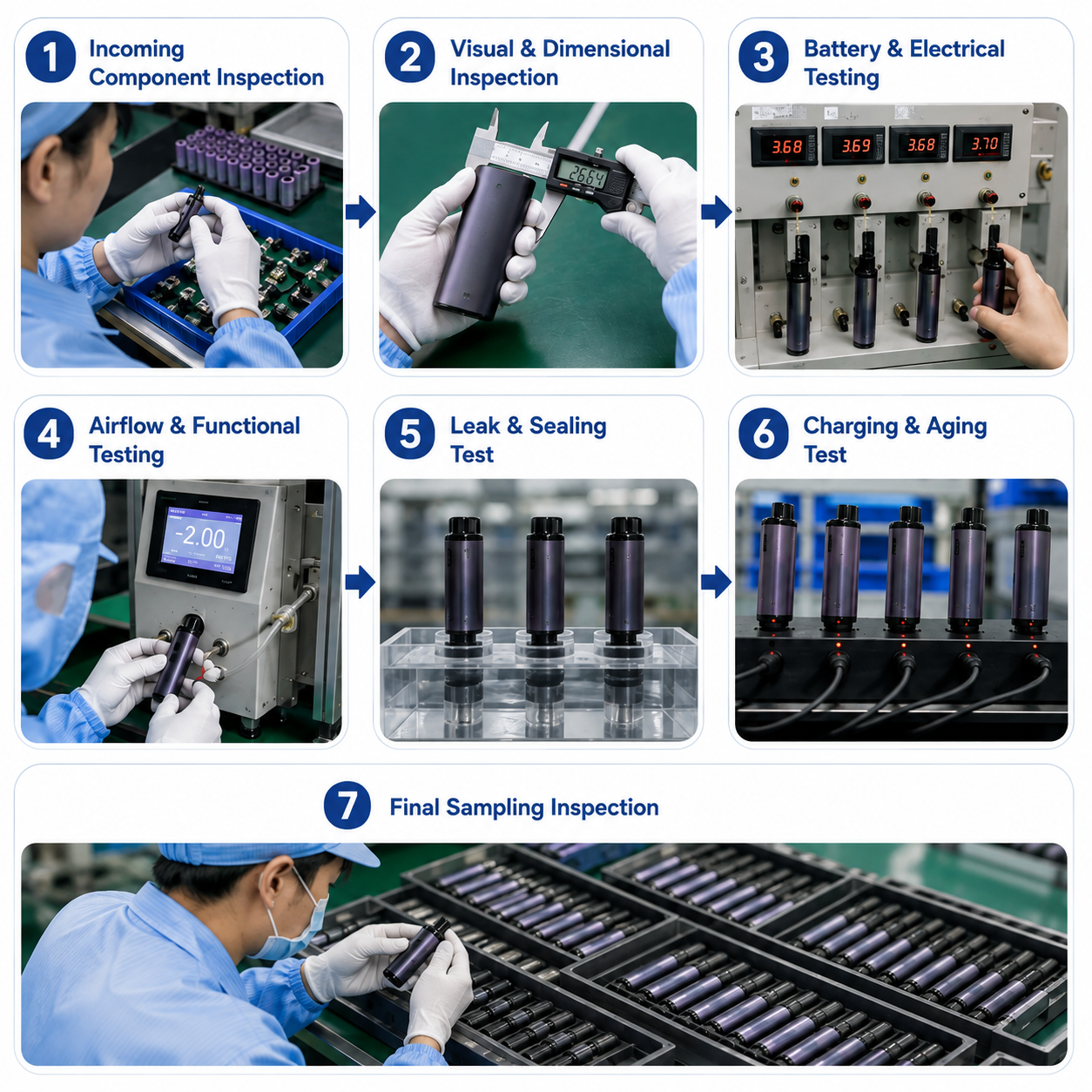
A typical bulk order can involve several stages of inspection:
Incoming component inspection
Visual and dimensional inspection
Battery and electrical testing
Airflow and activation testing
Sealing and leakage evaluation
Charging and aging checks
Final sampling and packaging inspection
The exact inspection plan depends on the product.
For example, a simple empty cartridge and a rechargeable 3-gram device with a display screen, dual chamber, draw sensor and USB-C charging port do not have the same number of potential failure points.
The more complex the hardware becomes, the more important it is to define critical inspection items before mass production begins.
Step 1: Incoming Component Inspection
Quality cannot be added at the end of the production line.
It starts with the components.
Before assembly, incoming components should be checked against the approved product specification and reference sample.
Depending on the device, these components may include:
battery cells;
PCB or control boards;
heating elements;
chambers or tanks;
silicone seals;
mouthpieces;
outer housings;
charging ports;
display components;
connectors;
packaging materials.
Battery Components
For devices containing rechargeable batteries, inspection may include checking the battery specification, condition, dimensions and electrical characteristics against the approved requirement.
Visible damage, deformation, incorrect wiring or inconsistent components should be identified before assembly.
Where applicable, battery documentation should also be reviewed.
This is important because lithium-battery transportation requirements are different from ordinary consumer-product QC. The United Nations’ current Manual of Tests and Criteria, Revision 8 with Amendment 1 (2025) includes Section 38.3 for lithium cells and batteries. Lithium battery types must satisfy applicable UN 38.3 requirements before transport.
For portable rechargeable lithium cells and batteries, IEC 62133-2:2017+A1:2021 is another important international safety standard. It addresses safety requirements and testing for portable sealed secondary lithium cells and batteries under intended use and reasonably foreseeable misuse.
These standards are not substitutes for daily factory QC. Instead, they demonstrate why battery sourcing, documentation and product-level functional inspection should be treated as separate parts of quality management.
Step 2: Visual and Dimensional Inspection
Not every quality problem requires sophisticated laboratory equipment to identify.
Many defects can be detected through disciplined visual inspection.
Our inspectors look for issues such as:
scratches;
dents;
cracks;
obvious color differences;
uneven gaps;
loose mouthpieces;
damaged charging ports;
incorrect printing;
misaligned components;
contamination;
deformation.
For OEM orders, artwork receives additional attention.
Logo position, color, orientation, packaging text and other customized elements should match the buyer-approved artwork or golden sample.
Dimensional Checks
For critical dimensions, tools such as digital calipers, gauges or production fixtures can be used to compare finished components against approved tolerances.
Measurements may include:
overall device dimensions;
chamber opening dimensions;
mouthpiece dimensions;
housing fit;
charging-port position;
component alignment.
The objective is not simply to make every device look identical.
The objective is to identify dimensional variations that may affect assembly, sealing, filling compatibility or product performance.
Recommended original image: A QC inspector measuring an empty vape device with a digital caliper.
Step 3: Battery and Electrical Testing
For rechargeable empty vape hardware, electrical performance is one of the most important QC areas.
Depending on the product design, testing may include:
Battery Voltage
Selected units can be measured to confirm that battery voltage falls within the product’s approved specification.
Draw Activation
For draw-activated devices, inspectors can check whether the sensor responds consistently when airflow is applied.
Possible defects include:
failure to activate;
delayed activation;
unstable activation;
activation without proper airflow.
Indicator or Display Function
If the device includes LEDs or a digital display, the inspection should verify that the indicator functions as designed.
For models with additional electronic features, those functions should be incorporated into the QC checklist rather than assumed to work because the basic battery circuit is functioning.
Step 4: Airflow and Functional Testing
Airflow is easy to overlook because it is difficult to judge from product photographs.
However, it can have a major effect on how consistently a device functions.
During functional inspection, selected units can be evaluated for:
normal airflow;
excessive airflow restriction;
blocked air channels;
draw-sensor response;
unusual noise;
inconsistent activation.
For a B2B buyer, the important question is not whether one device activates correctly.
It is whether the batch demonstrates acceptable consistency.
This is where recording actual test results becomes valuable.
Step 5: Sealing and Leakage Testing
Leakage is one of the most common concerns when buyers evaluate empty vape hardware.
However, it is important to understand that leakage is not determined by hardware alone.
Performance can also be influenced by:
formulation viscosity;
filling temperature;
filling volume;
filling technique;
time between filling and capping;
storage orientation;
transportation conditions;
temperature changes;
compatibility between the formulation and hardware.
For this reason, responsible hardware evaluation should avoid unrealistic claims such as “100% leak-proof.”
Instead, the goal is to evaluate the mechanical factors that can contribute to leakage and test the device under defined conditions.
What We Inspect
Hardware-related checks may include:
silicone-seal condition;
chamber integrity;
mouthpiece fit;
assembly gaps;
damaged sealing surfaces;
component deformation;
connection between chamber and heating structure.
Where filled sample testing is appropriate and legally permitted, compatibility testing should use the buyer’s intended formulation or a defined test material and documented conditions.
Possible evaluation methods can include:
upright storage;
horizontal storage;
inverted positioning;
defined observation periods;
temperature-controlled tests where appropriate.
Our standard observation period: 24/48/72 hours
The most useful result is not simply “passed.”
A good test record should identify:
what was tested, how many units were tested, under what conditions, for how long, and what result was observed.
A working draw sensor does not automatically mean the charging system works correctly.
Charging checks can include:
USB-C or other port connection;
charging initiation;
charging indicator behavior;
charging completion;
abnormal interruption;
unusual temperature increase;
physical condition of the charging port.
Selected samples may also be held for an aging or observation period before final shipment.
The purpose is to identify faults that may not appear immediately after assembly.
Depending on the product, the inspection may focus on:
abnormal battery discharge;
sensor instability;
charging abnormalities;
electrical failure after storage.
Step 7: Final Sampling Inspection Before Shipment
Testing every characteristic of every finished unit is not always practical.
For that reason, industrial quality control often combines process inspection with statistically structured final sampling.
One important development for buyers in 2026 is the publication of ISO 2859-1:2026, the third edition of the international standard for sampling procedures for inspection by attributes.
Published in January 2026, the new edition replaced ISO 2859-1:1999 and provides AQL-indexed sampling schemes for lot-by-lot inspection. It also includes updated sampling guidance and skip-lot procedures.
AQL stands for Acceptance Quality Limit.
It should not be interpreted as a promise that a certain percentage of defective products will be deliberately shipped. Instead, AQL-based inspection is a statistical method used to establish sample sizes and lot acceptance or rejection criteria.
At VapeBulkPro, the final sampling plan should be defined according to the order, product and agreed buyer requirements.
Final checks can include:
model verification;
color verification;
appearance;
function;
charging;
quantity;
OEM artwork;
accessories;
packaging;
labels;
carton marks.
What Happens If a Device Fails QC?
A credible QC system should not pretend defects never occur.
Manufacturing involves variation.
The important question is how a factory identifies and controls that variation.
When a unit fails an inspection, a typical corrective process can include:
isolating the nonconforming unit;
identifying the defect;
determining whether rework is permitted;
replacing or reworking affected units;
performing another inspection;
investigating repeated defects;
releasing the batch only after the required acceptance criteria are met.
Repeated defects should receive more attention than isolated cosmetic issues because they can indicate a process, material or assembly problem affecting a wider portion of the production lot.
For buyers, this is why asking only “What is your defect rate?” is not enough.
A better question is:
“What happens when your inspection finds a defect?”
Sample Approval Is Not the Same as Bulk Production Approval
One of the most important lessons for wholesale buyers is that approving a sample is only the beginning.
A useful quality-control structure can include:
Stage
Purpose
Initial sample
Evaluate design and basic performance
Golden sample
Establish an approved quality reference
Incoming inspection
Check key materials and components
In-process QC
Identify production problems early
Finished-goods inspection
Verify completed devices
Pre-shipment inspection
Decide whether the lot is ready for release
The golden sample is particularly important for OEM projects.
It gives both buyer and supplier a physical reference for appearance, dimensions, printing, packaging and function before mass production begins.
QC Does Not Replace Shipping or Regulatory Compliance
Quality inspection and regulatory compliance are related, but they are not the same thing.
A device can pass factory QC and still require additional documentation or face shipping restrictions in its destination market.
Lithium batteries are one example.
The 2026 IATA guidance for lithium and sodium-ion batteries reflects current dangerous-goods requirements for air transport, while UN 38.3 addresses the testing of lithium cell and battery types before transport.
Vape hardware can also face product-specific rules.
In the United States, for example, ATF’s current PACT Act guidance defines ENDS broadly enough to include devices delivering nicotine, flavor or another substance, and includes components, parts and accessories. ATF specifically states that CBD- and THC-related electronic devices can fall within this PACT Act definition.
USPS similarly states that its ENDS definition includes components, liquids, parts and accessories regardless of whether they are sold separately or used with nicotine.
Therefore, buyers should verify the regulations, carrier requirements and documentation applicable to their specific product, intended use and destination.
This article provides general manufacturing and quality-control information and is not legal or regulatory advice.
What Buyers Should Check Before Approving a Bulk Vape Hardware Order
Before moving from samples to mass production, we recommend that professional buyers confirm at least the following:
device capacity;
battery specification;
chamber configuration;
coil or heating structure;
airflow design;
charging system;
OEM artwork;
packaging;
critical dimensions;
formulation compatibility where applicable;
acceptable cosmetic standards;
functional testing requirements;
inspection method;
sampling plan;
shipping documentation;
destination-market requirements.
For larger OEM projects, these requirements should be documented before mass production rather than discussed only after the goods are completed.
Frequently Asked Questions
Do you test every empty vape device before shipping?
Different inspection stages may use different methods.
Some characteristics can be checked during production, while other inspections use statistically defined sampling. The appropriate approach depends on the model, production process, order quantity and buyer requirements.
For final lot inspection, internationally recognized sampling frameworks such as ISO 2859-1:2026 can be used where appropriate.
What is AQL inspection for vape hardware?
AQL-based inspection uses a defined sampling plan to determine how many units should be inspected from a production lot and what acceptance or rejection criteria apply.
ISO 2859-1:2026 is the current international standard for AQL-indexed lot-by-lot inspection by attributes.
The exact inspection level and AQL values should be agreed according to the product and buyer’s quality requirements.
How do you test empty vape hardware for leakage?
Testing focuses first on hardware-related sealing factors such as chamber integrity, silicone seals, mouthpiece fit and assembly consistency.
Where filled testing is conducted, the test conditions should also document formulation, filling method, storage position, temperature and observation time because these variables can influence leakage.
Do rechargeable vape devices require additional testing?
Yes.
Rechargeable devices introduce additional potential failure points, including the battery, charging port, charging circuit, indicator and electronic protection system.
Battery-related documentation and applicable transport requirements should also be verified separately from functional QC.
Can buyers request their own QC requirements?
For OEM and larger wholesale projects, buyers can define product-specific inspection requirements before production.
This may include additional measurements, cosmetic standards, packaging checks, sample approval procedures or third-party inspection where available.
The most important step is to define these requirements before mass production begins.
Final Thoughts: Good QC Is About Evidence, Not Promises
There is a major difference between saying a vape device is “high quality” and demonstrating how its quality was evaluated.
For professional wholesale buyers, meaningful quality control should answer five questions:
What was tested?
How was it tested?
How many units were tested?
What were the acceptance criteria?
What happened when a unit failed?
That is the information buyers need when evaluating a long-term empty vape hardware supplier.
At VapeBulkPro, our goal is not simply to show buyers a finished product. We want buyers to understand the inspection process behind a bulk order—from component evaluation and functional testing to final sampling and packaging inspection.
If you are preparing an OEM or wholesale empty vape hardware project, contact our team to discuss product specifications, sample evaluation, packaging requirements and the QC standards required for your order.
References and Standards
ISO 2859-1:2026 — Sampling procedures for inspection by attributes, Part 1. Published January 2026 and replacing the previous 1999 edition.
UN Manual of Tests and Criteria, Revision 8 + Amendment 1 (2025) — Current United Nations reference containing Section 38.3 requirements relating to lithium cells and batteries.
IEC 62133-2:2017+A1:2021 — Safety requirements and tests for portable sealed secondary lithium cells and batteries.
IATA Lithium Battery Guidance Document 2026 — Current air-transport guidance concerning lithium and sodium-ion batteries.
Hello, please contact us if you have any questions! Whatsapp : +1-713-363-1015 Telegram : @Amy99812 Email : chengstella120@gmail.com iMessage: +1-713-363-1015
We have received your message and we will contact you as soon as possible!